
Nearly 60 Years Later: The Nixons
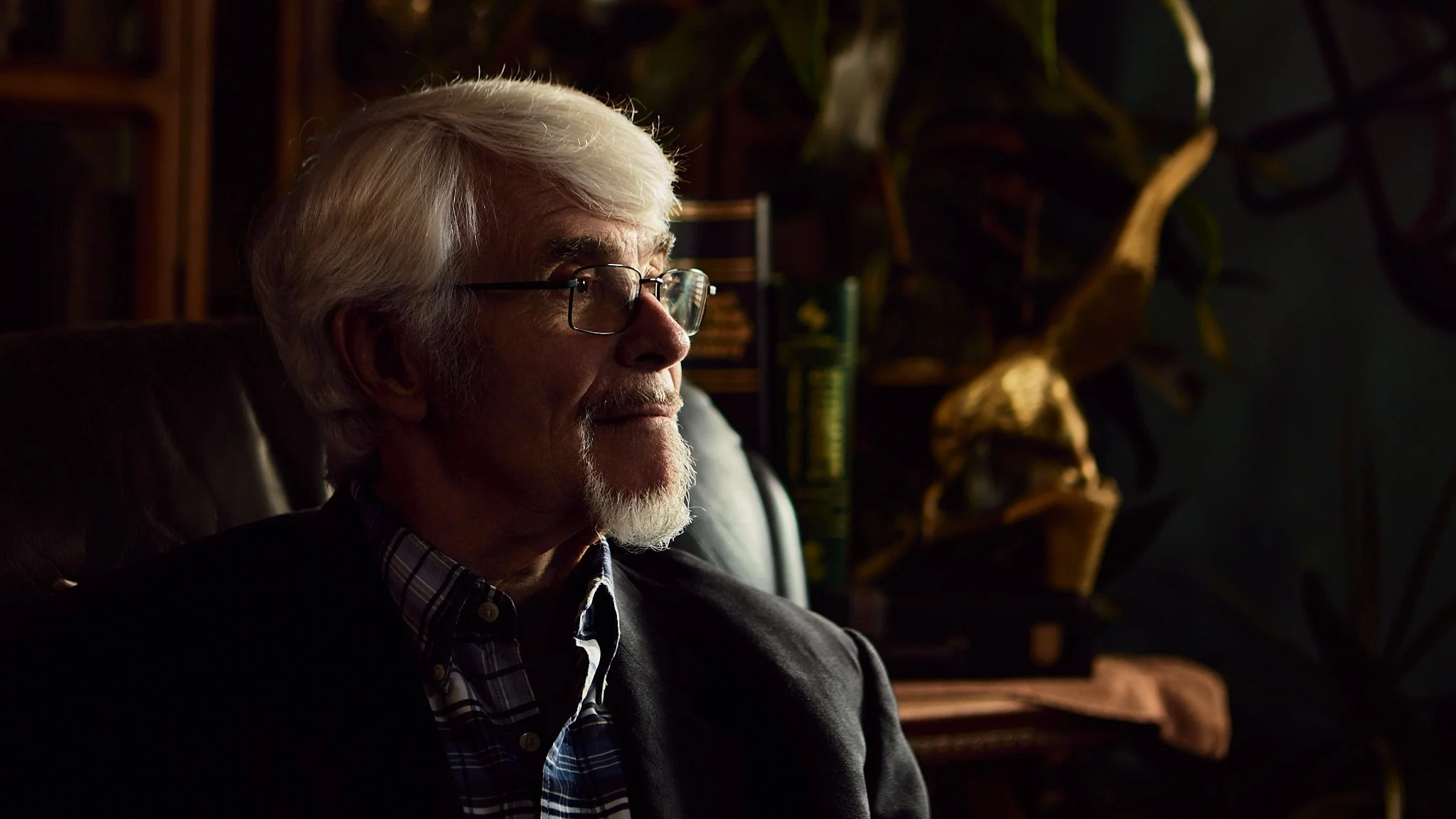
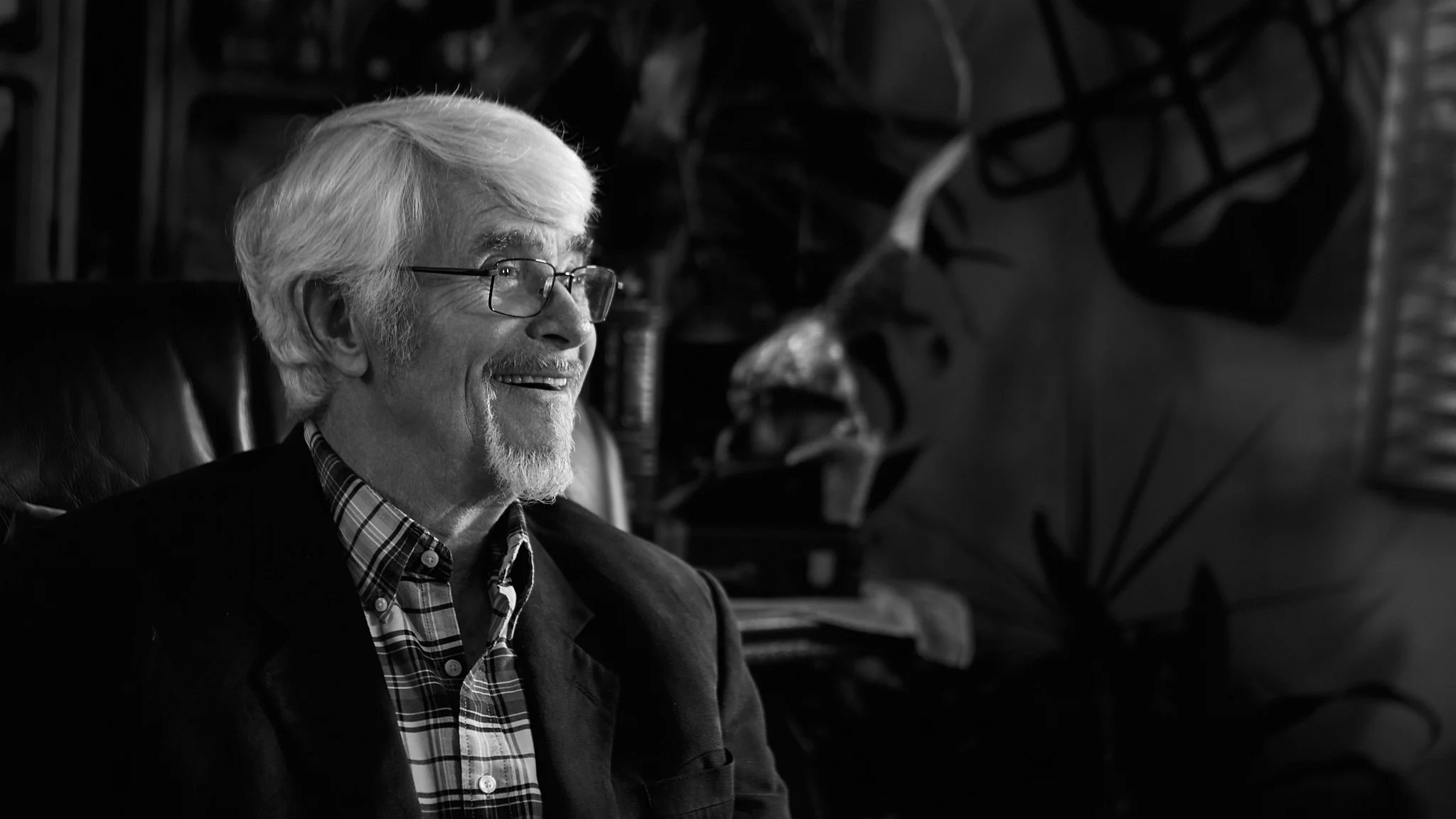
Donald Nixon Jr., age 80. Nephew of President Richard Nixon, Photographed by Julian Arceo, May 20, 2026.
It was November of 1968, and the call had just come in. Richard Nixon had won. Uncle Dick was going to be President of the United States. I asked Donald what that moment felt like, sitting in his living room more than fifty years later, and he did not pause to find the right word.
DONALD: Nothing.
But here is the thing. He did not say it lightly. He said it slowly, and he held my eyes when he said it, stern, almost daring me to look away first. I have come to believe that “nothing” was not the absence of feeling. It was the cost of it. It was what a young man learns to say when his whole life is about to change and there is not a single thing he can do to stop it. You do not feel nothing on a night like that. When your uncle is about to become the President of the most powerful country in history, you decide to.
The timer ticked on the counter. Thirteen minutes to dinner. He went back to shredding his chicken.
DONALD: Another bottle?
I looked at my watch. Six hours in, and I felt like I had not asked a real question yet. I have spent more than a decade learning to read people in front of a camera, and that one word told me more than anything else he would say all day. So let me take you back to the start of it.
BREAKFAST
Most people do not actually want their picture taken. A portrait asks you to be seen, and being seen is harder than people let on. Once in a while, though, you meet someone who is not fighting it at all, who is simply himself the whole way through. Donald is one of those. I came to photograph him and found him at the stove, making chili. Beans, tomatoes, eggs, and then a long pour of maple syrup straight into the pot. A first for me.
There was a young man at the table, Theo, somebody Donald had taken under his wing, and the kid looked me up and down in my suit like I'd shown up to fix the cable. He was informed that morning that I’d be taking his photo.
THEO: No offense, but this is my personal nightmare. I hate getting my photo taken.
JULIAN: Honestly, most people I work with could resonate with that. But I specialize with the ones who hate it. You are in good hands.
THEO: I’ve heard it all before. I am telling you, this is the least excited I have been in my entire life.
JULIAN: I can’t promise you’ll cat walk out of here loving photos, but I can guarantee you won’t mind me taking yours again.
The people who walk in dreading the camera have always been my favorite, because the distance between where they start and where they end up is so much wider, and when somebody who hates the lens looks at the back of the camera and goes quiet for a second, that's the whole job done in a single breath.
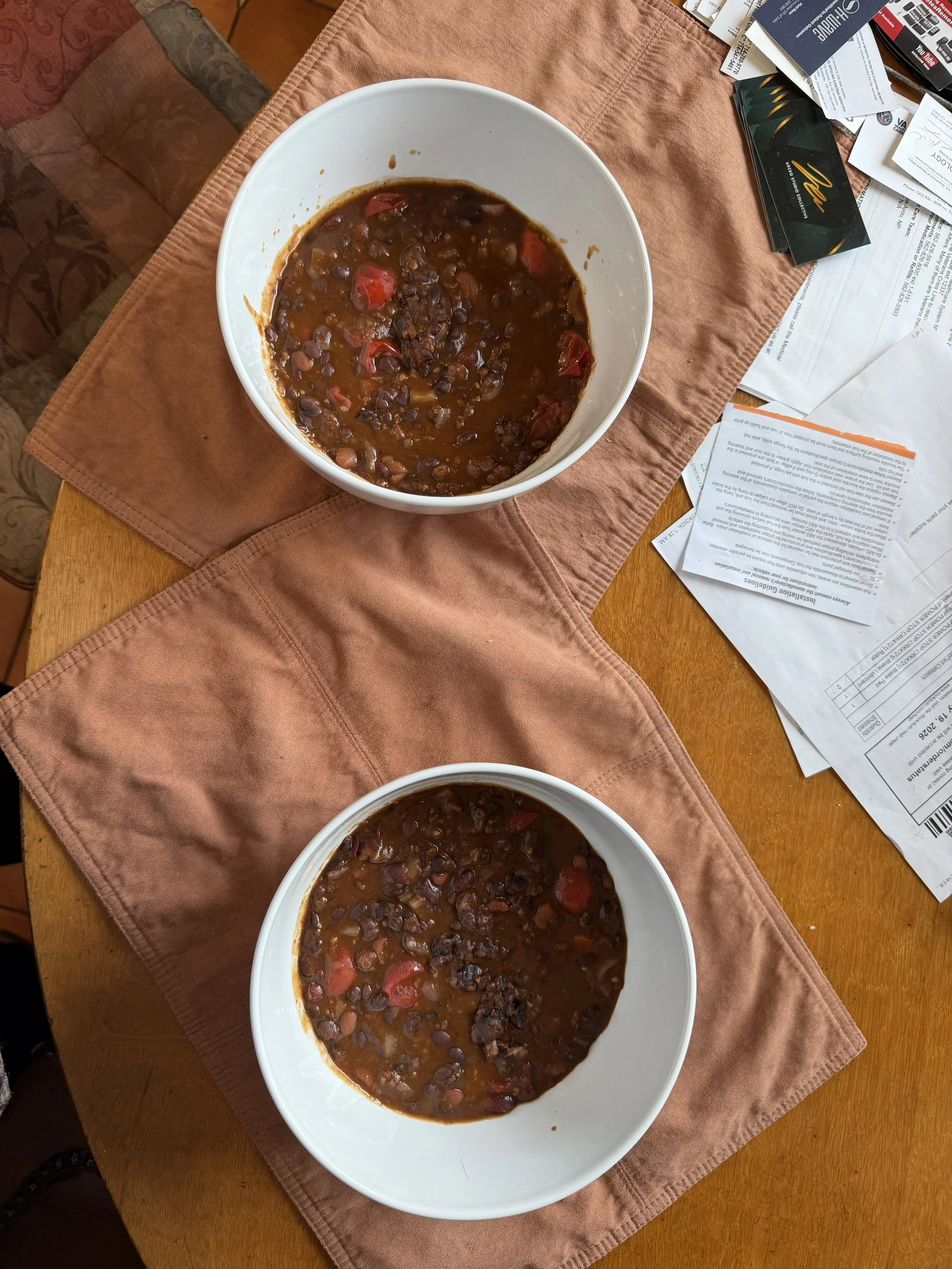
Donald’s “Mess” - Black beans, chili, cherry tomatoes, maple syrup, optional fried egg. No further questions.
DONALD: You look so clean. You look almost furious in that suit.
JULIAN: It's a respect thing. I can't ask you to dress up if I won't. Think of it as a clown's makeup. I can't be a clown without it.
We ate first, which matters more than people think, because the conversation is how you get the photograph. The camera waited in its bag across the room as we began breaking the formalities. With my recorder on the table, we got right into it.
First Recordings
DONALD: Well, I’m ready for my obituary photo!
JULIAN: You know, most of my clients walk in saying that.
DONALD: Really?
JULIAN: Almost all of them. I call them legacy shots for a reason. How do you want to be remembered? A Facebook photo with the sunglasses on, on a cruise ship? Or something clean and artistic that gets passed down for generations? What does civilization see when it looks back at us in a hundred years?
DONALD: That’s a little cheesy, you know.
JULIAN: It could be. But it is history. People will find it interesting. I intend to leave my mark. Just as artists like Rembrandt did for his time.
He waved me off. Twenty minutes later he was the one leading me up the stairs to find an old invitation he wanted me to see. He tells you he doesn't care, and then he shows you exactly how much he does.
We set up for Theo's portrait, and Theo started eyeing Don nervously. It popped into Don's head:
DONALD: He's worried about the, the stuff up there, the blemishes. Is there a way to—
JULIAN: Oh, we don't worry about that at all. Now you’ll see why they don't just call me a photographer. They call me a magician.
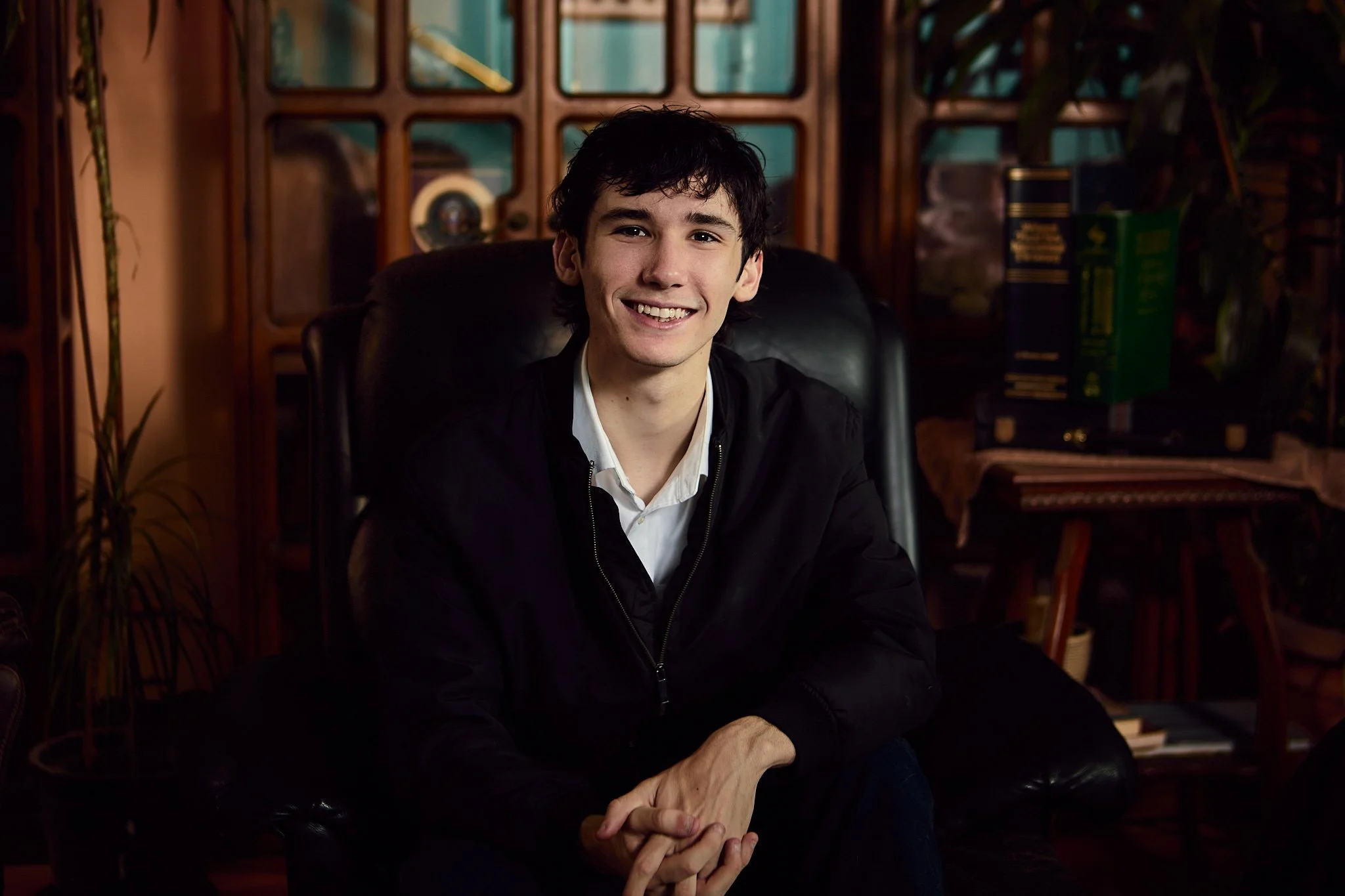
Theo’s Portrait. He survived.
JULIAN: Take me into a normal week for you these days. What's life like now that you're retired? I'm using air quotes you can't see.
DONALD: I'm never going to retire. I'm head of the Nixon family.
JULIAN: What's that like?
DONALD: Busy. There's this thing going on in China, they treat me like I'm my uncle over there. Last trip, I'm going through customs, and I've got a business card from the Chinese ambassador right there in my hand. The officer sees it, and all of a sudden everybody wants pictures. A guy who barely spoke English looks at me and goes, so you're one of the Nixons! I said yes. Made his whole day.
JULIAN: They knew the name.
DONALD: My birthday came up while I was over there. Every city threw me a dinner. Hundreds of people. And then they'd march me up on a stage and I'd have to give a speech. Didn't warn me once. Five cities. Five speeches.
JULIAN: And you just winged it five times?
DONALD: I'm good at that. And if there's ever any doubt who I am, I hand them my card. It doesn't have a phone number.
JULIAN: I've noticed that about your card.
DONALD: I know where to find you.
He says it with a grin, knowing exactly how that sounds. I wanted to make this piece because Donald has lived a remarkable life, drafted out of college and sent to serve in Vietnam, sent abroad young and often, and somehow he came out the other side a warm and funny man who still believes the point of any of it was the people. He grew up in Whittier during a time when the iceman still came around to keep the fridge cold for the week. The stories pour out faster than anyone could write them down, and he is not afraid of detail.
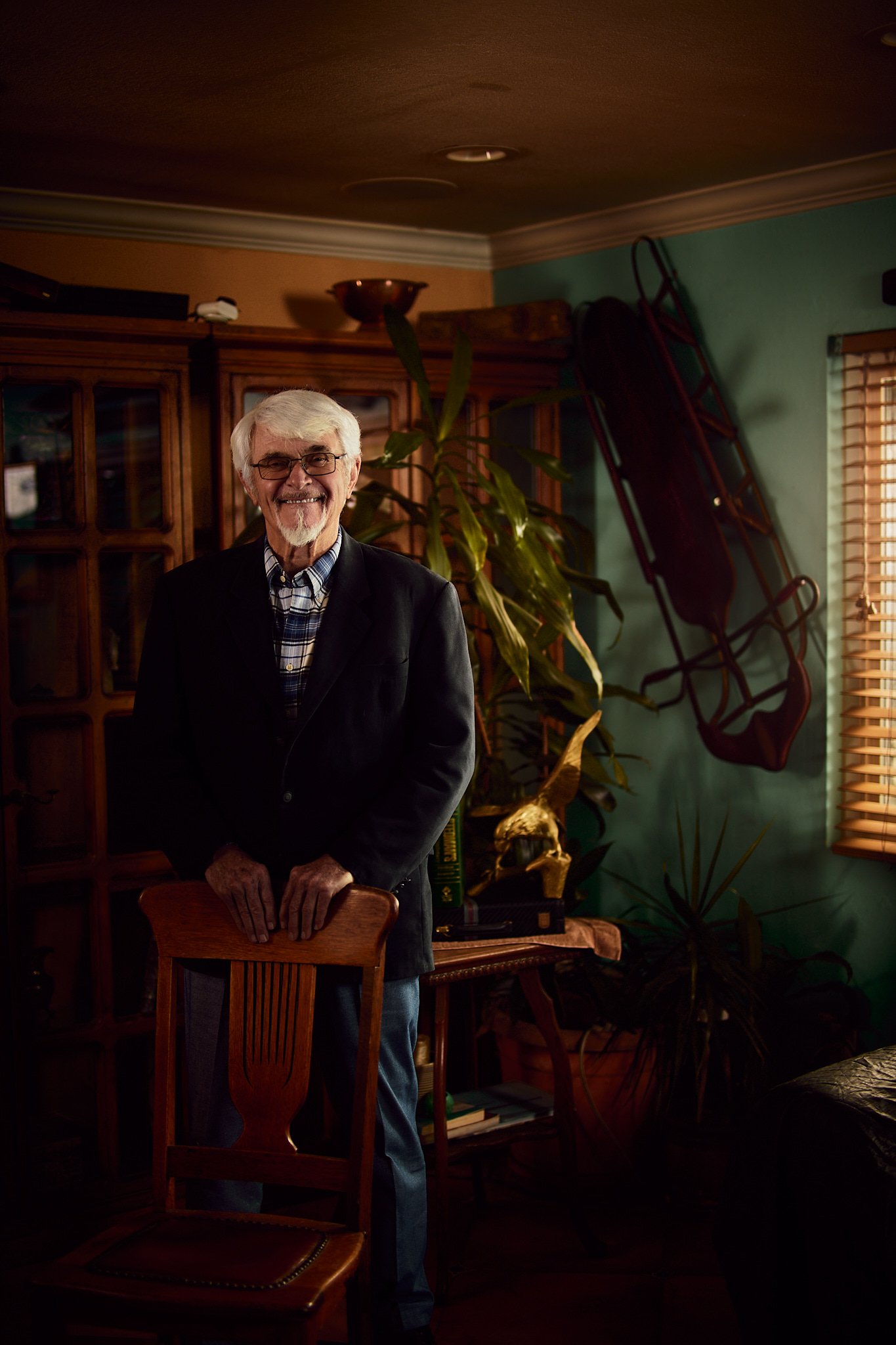
Don, proud of his bobsled he used while staying in the Sequoias.
The Family
The famous parts he tells flat, no drumroll, because to him these were just the people in the room.
JULIAN: [Posing him] All right, I'm unbuttoning the coat. Don't lean back, or it starts to look like a wheelchair photo from my angle. Lean forward, look a little lively, shoulder blades back, chin up.
DONALD: It's hot waiting. You're making me work here.
JULIAN: Takes time to make art. Rome wasn’t built in a day.
[Posing his hands.]
DONALD: I am thinking more Eisenhower for this one. I knew him. Back in the day, when Dick was his VP.
JULIAN: You have stories about that?
He had a few. He used to sit on Dwight’s lap during family dinners as a child. He was at the inauguration as a young man, up near the front, cold the way Washington always is in January, and began naming the people one at a time, like neighbors. The men who ran the country, to him, were the grown-ups who were at the family functions.
His uncle is Richard Nixon, and the record of the presidency is its own thing: he opened relations with China and signed landmark arms control treaties with the Soviet Union, created the Environmental Protection Agency, saw the Clean Water Act and the Occupational Safety and Health Act become law, ended the draft in 1973, extended the Voting Rights Act, advanced the first federal affirmative action plan, and lowered the voting age to eighteen with the Twenty-sixth Amendment. When Donald talks about it, he is not bragging. He is telling you about family.
JULIAN: What did you watch Uncle Dick (Richard Nixon) do well that the public never got to see?
DONALD: He was a master at economics. A whole plethora of knowledge, and humble with it. And one thing people do not know. My Uncle Dick gave millions of acres of federal land back to the Native American tribes. A whole bunch of them. He must have been one of the first to ever do that. He did his best to do things for the people.
JULIAN: Is there a piece of advice he gave you that stuck, something you would pass on?
DONALD: Always tell the truth.
JULIAN: I like that one. It is close to what I tell every photographer I train. Do not rush to be impressive. Learn to be honest first.
The young man Donald has under his wing, Theo, was sitting right there watching me pose him while discussing his legacy. It struck me that Donald is doing for that kid exactly what I try to do for the people I bring up, teaching by showing rather than lecturing. We said our goodbyes to Theo as he had to head home, and now it was my time to dig deeper with Don.
He started talking about his father, a Marriott executive, the man behind every lesson Donald lives by.
DONALD: That's just the way my dad taught me to do things.
He must have said that line five times that day, and every time it came out a little softer. Once, in the middle of it, his voice caught. He stopped, grinned, looked off toward the window for a second, the way a man does when a memory walks into the room and sits down next to him. Then he came back. He did not apologize for the pause, and I did not fill it. Some men carry their fathers around for eighty years and still tear up at the sound of them. That is not weakness. That is the love outliving the man.
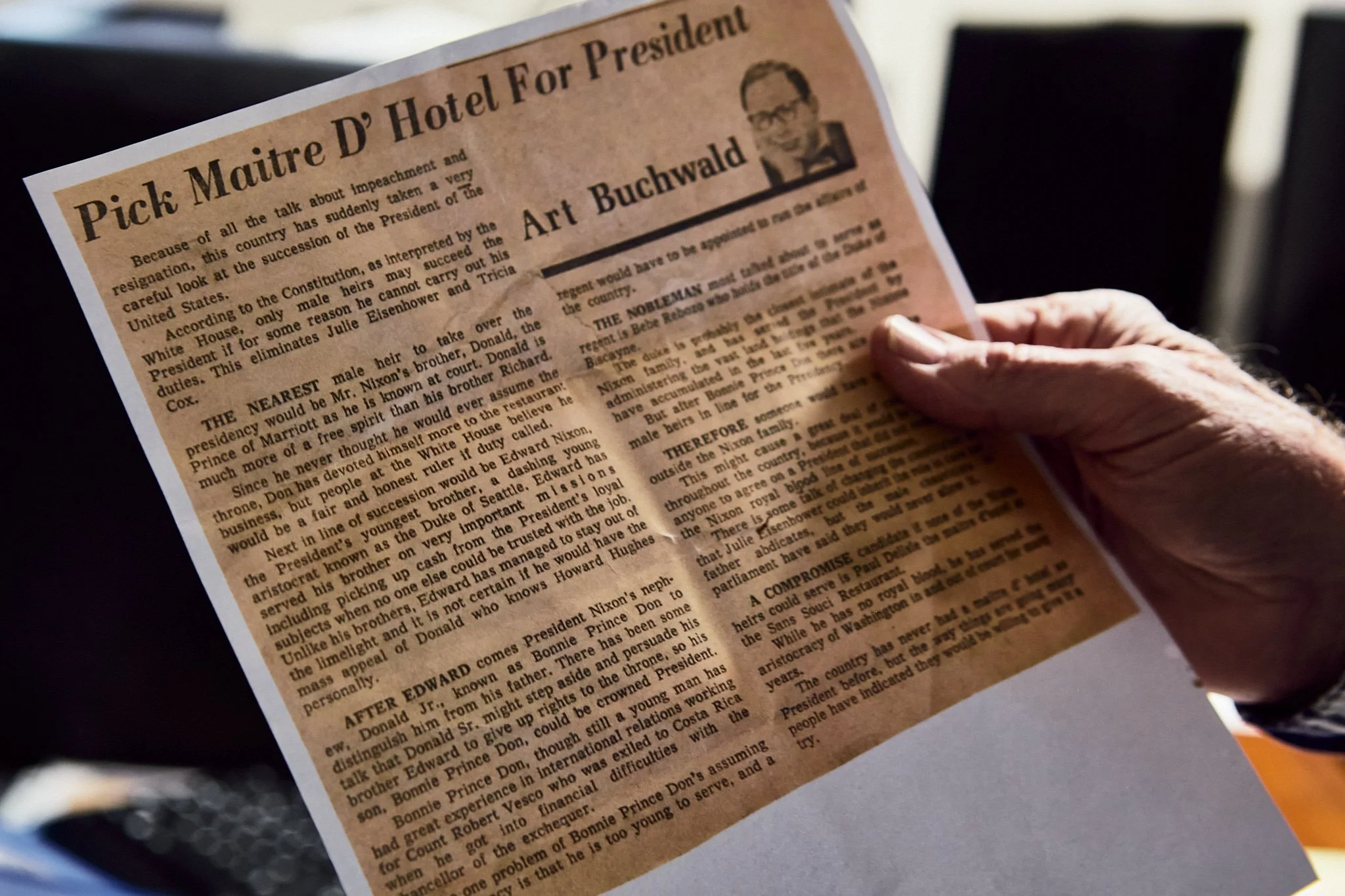
He handed me a yellowed clipping and made me read it. An old Art Buchwald column, written during the impeachment talk, half-seriously working out who would run the country if the line of succession ran dry. Buchwald lands on the Nixons, dubs the father the Prince of Marriott, and arrives, tongue all the way through his cheek, at Donald himself. Bonnie Prince Don. The next head of the family, noting his great experience in international relations. Donald keeps it because it is funny, and because underneath the joke it is a piece of paper that crowns him, and he knows it. Buchwald, who spent a career laughing at power, once wrote that whether it is the best of times or the worst of times, it is the only time we have. Donald has taken that to heart more than most.
The Travels
From here, the stories began to tumble into one another. One country bleeding into the next until you stop trying to keep the timeline straight, is the entire point of sitting with him.
DONALD: You got the thing going? The tape going?
JULIAN: Rolling.
DONALD: After my Vietnam Navy days, with the jarheads, running around helicopters and stuff.
JULIAN: Happy Memorial Day, by the way.
DONALD: Right. Thanks. Then I helped put on a rock festival. Assisted with food and drink. And right when it wrapped, I get a phone call. My uncle. He goes, do you have a passport? You're going to Switzerland. I said, Switzerland? To do what? He goes, I'll tell you when you get there. You leave at 0900.
JULIAN: That's it? No briefing?
DONALD: They got me a passport in forty minutes. That night I'm in Geneva. Eventually I had to leave and go to Germany. Then Nassau. Unbelievable travels.
He tells the whole thing with a shrug, a young man yanked out of one life and dropped into another across an ocean on a day's notice, which was apparently just the shape of his twenties.
He has spent years in China, and he loves it there. His favorite story is a small one. On an early trip he asked the hotel staff what they actually wanted from California. They said beef jerky.
DONALD: So the next trip, I brought three big boxes. And when I arrived, they'd lined up the whole staff along the drive just to say hello. So I went down the line. Here, here, here. Jerky for everybody. My God, it was a treat. That's just the way my dad taught me to do it.
He swelled telling that one. Not bragging, prouder than that, the quiet pride of a man who took his father's one lesson and carried it to the other side of the world and watched it work on strangers who did not share his language. Kindness goes out, kindness comes back. He has built a whole life on it, and in that moment you could see he knew it had been the right bet.
It is worth pausing on one thing, because it runs straight through his life. In 1972, Richard Nixon became the first sitting American president to set foot in the People's Republic of China, ending more than twenty years of silence between the two nations. They called it the week that changed the world. So when Donald lights up describing his own decades there, there is a thread running back to the door his uncle opened. The family business, in a sense, was connection.
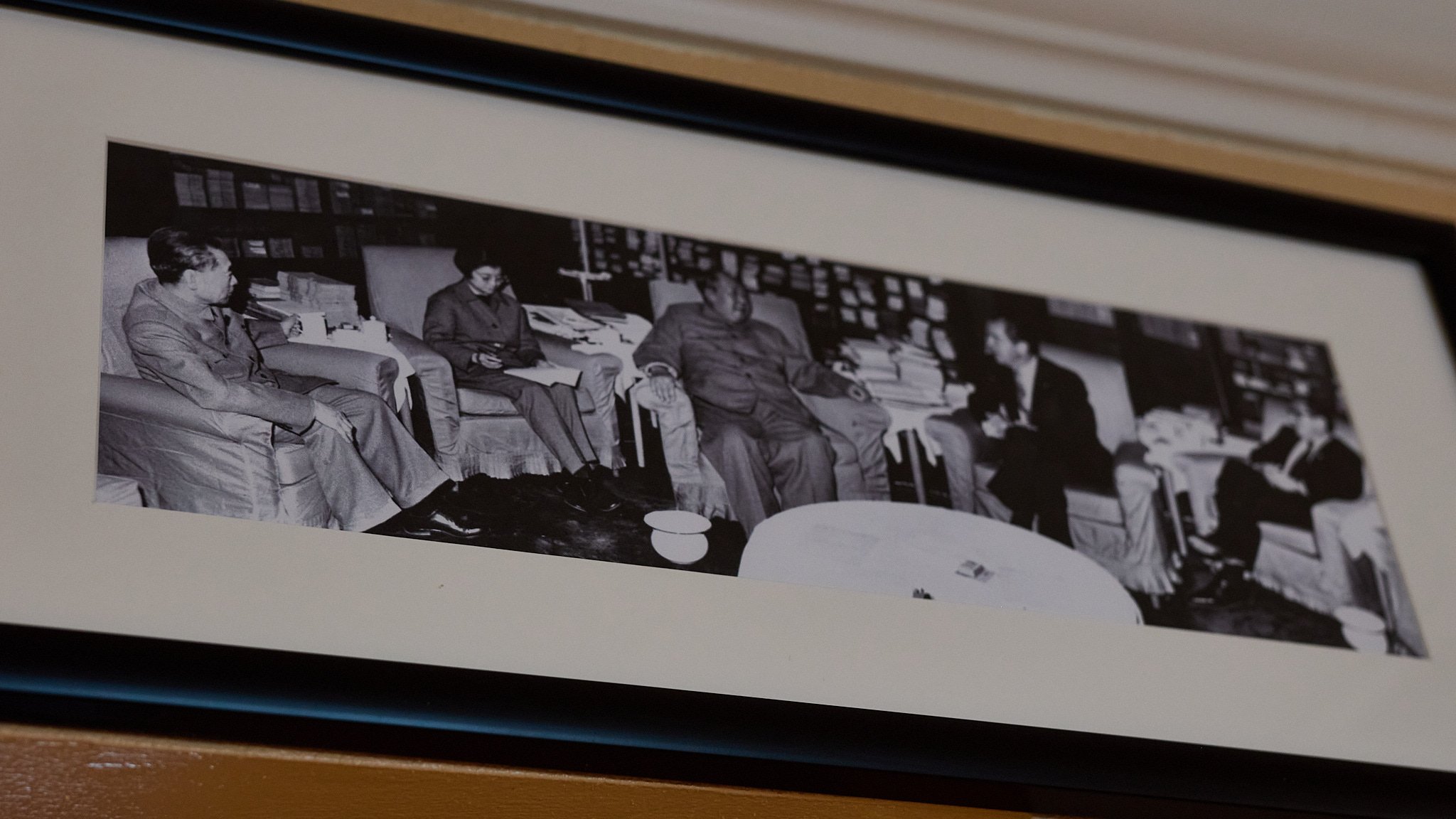
A photo of Richard Nixon with Mao, hanging in Don’s garage.
He kept going. Cities carved into the mountains. A Beijing so clean you can't find a cigarette end on the pavement. Cars all electric now. He marveled at it like a boy.
And there were the winters at Mineral King, in the Sequoias, where he ran a lodge and flew skiers to the top by helicopter. He has a hundred stories from those years, told at full speed, and some of them you simply let go by.
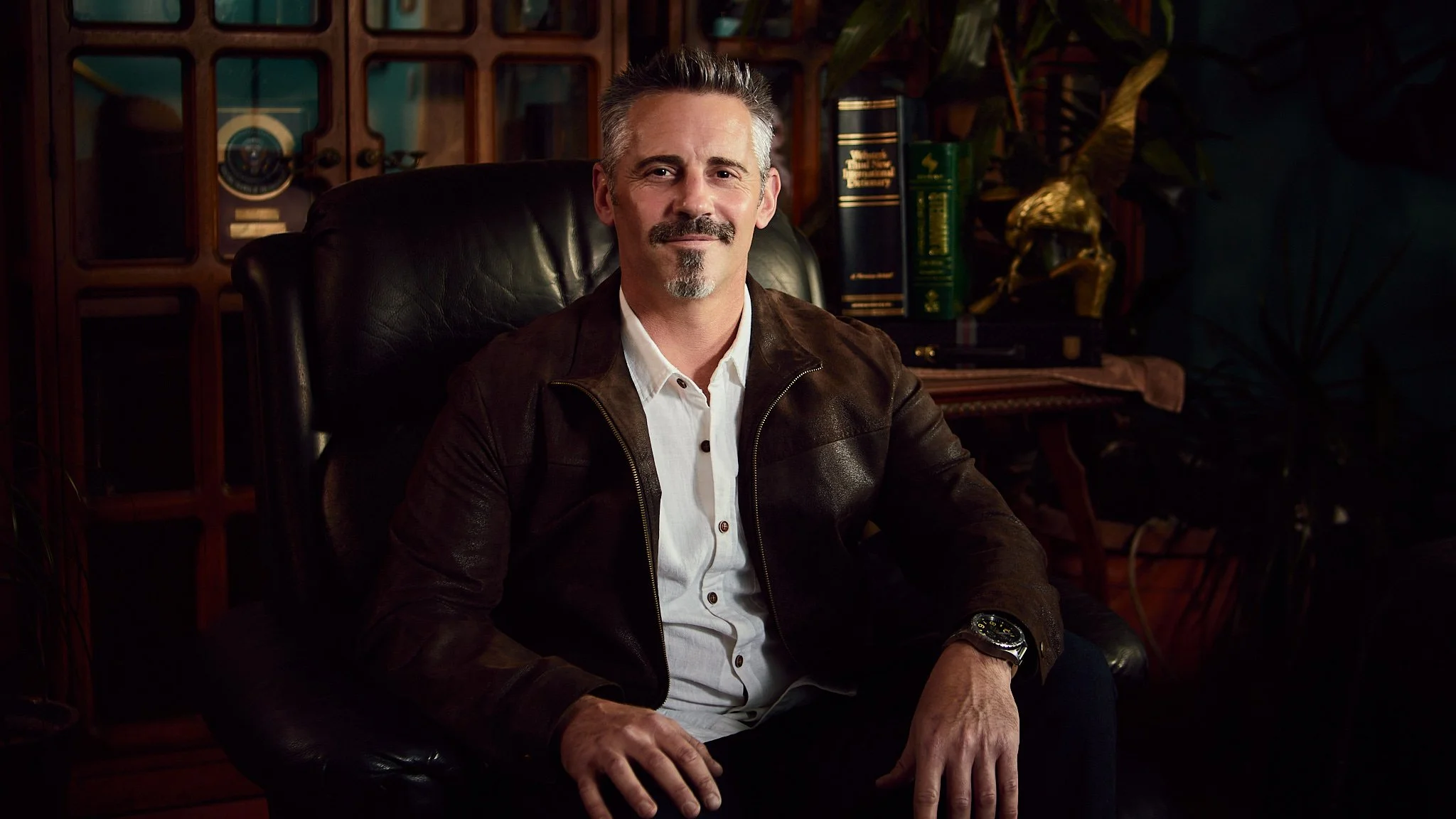
Donald’s Son - Devon Nixon.
The Family Lives On
Donald was not the only one at the house that day. His son was there too, a younger man with the same easy way of talking, and the same passport-stamps-for-a-childhood quality to his stories.
DEVON: I did a week in Japan and a couple weeks in Thailand before I moved to China.
JULIAN: How long were you in China for?
DEVON: Twelve years.
JULIAN: So you know Mandarin?
DEVON: I know good Mandarin. Did business a long time.
JULIAN: I had many Chinese clients when I photographed around Los Angeles, so I had picked up a few phrases over the years. Like tái qǐ lái, or “to lift up” as I point to their chin. Older folks let their heads drift down without realizing it, so I say it and they pop right back up with the biggest smile. Beats asking the grandkids to translate every five minutes.
DEVON: You learned that for your work. That’s great. You know what one you really need, then.
JULIAN: Teach me.
DEVON: Màn man lái. It means take your time. Slowly, slowly, it will come. You can use it for anything. Somebody is rushing, somebody is nervous in front of the camera, you just say màn man lái, take your time, we will get there. Automatic smile.
JULIAN: I love that. That is going straight into the kit.
He taught me a couple more on the spot, the kind you only know if you've actually lived somewhere. A son adding his own thread to his father's story, and one of my favorite moments of the day, because you could see the whole family was cut from the same restless, well-traveled cloth.
The Session
JULIAN: Foot up on the box for me, Don. That helps the posture. Shoulder blades back. There. Now lean forward toward me a little, like you are about to tell me a secret.
DONALD: You are awfully bossy for a clown.
JULIAN: I earned my clown makeup. Chin down just a hair. Beautiful. Now we break it with a smile.
— [SNAP!] —
JULIAN: Wow, that looks really good Don! I didn't know you could look that good.
DONALD: Neither did I!
That's the process. Small corrections, a little back and forth, until the person stops performing and just exists, and that's the frame you keep. My camera writes a file big enough to print him the size of a door, which is the point, because the greatest honor in this work is the picture going up large on a wall and staying there long after the morning is forgotten.
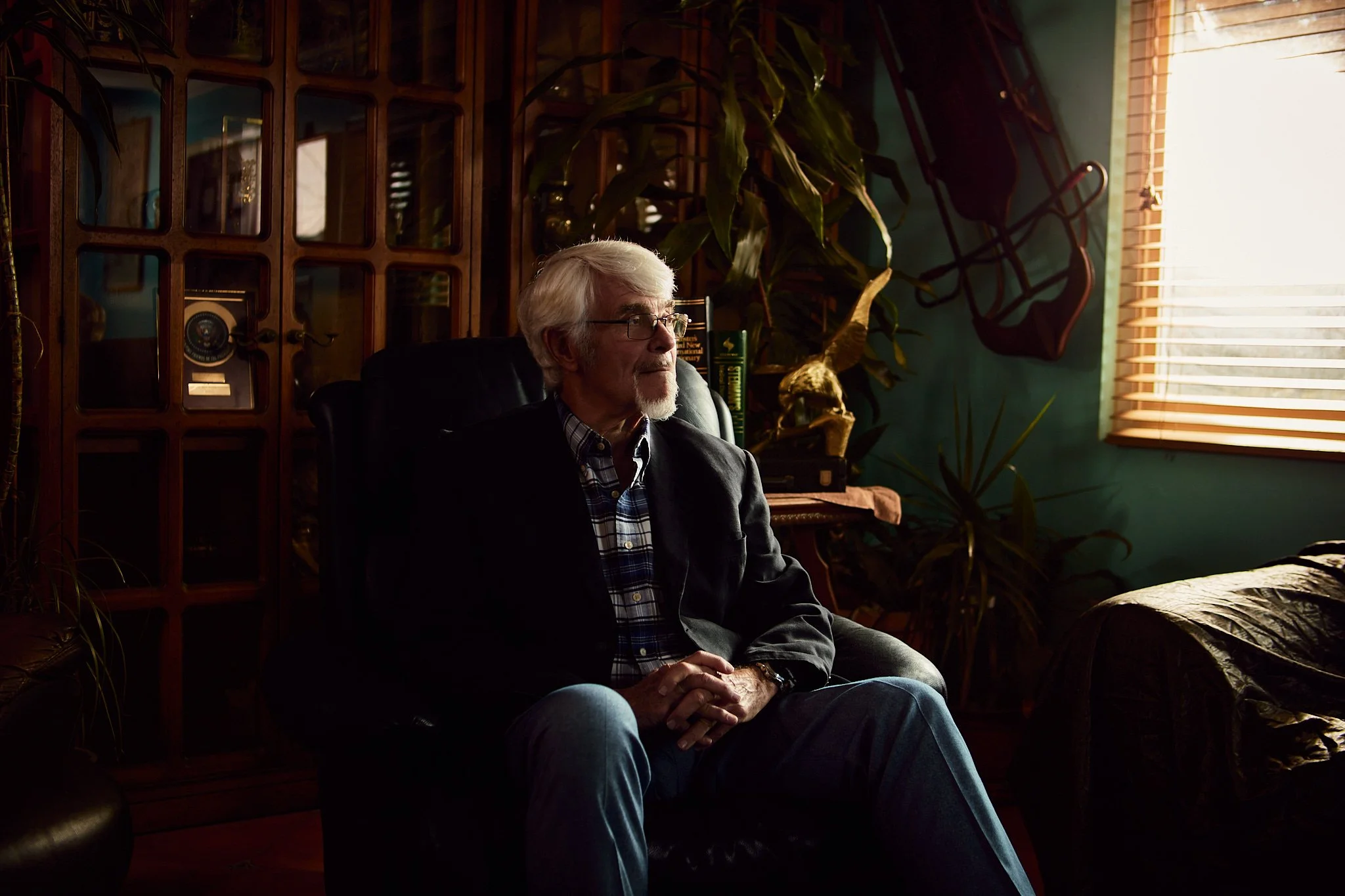
Don, listening to Theo, with a look in his eye that pushed me toward this stronger short-backlit portrait instead of the traditional bright, broad lighting.
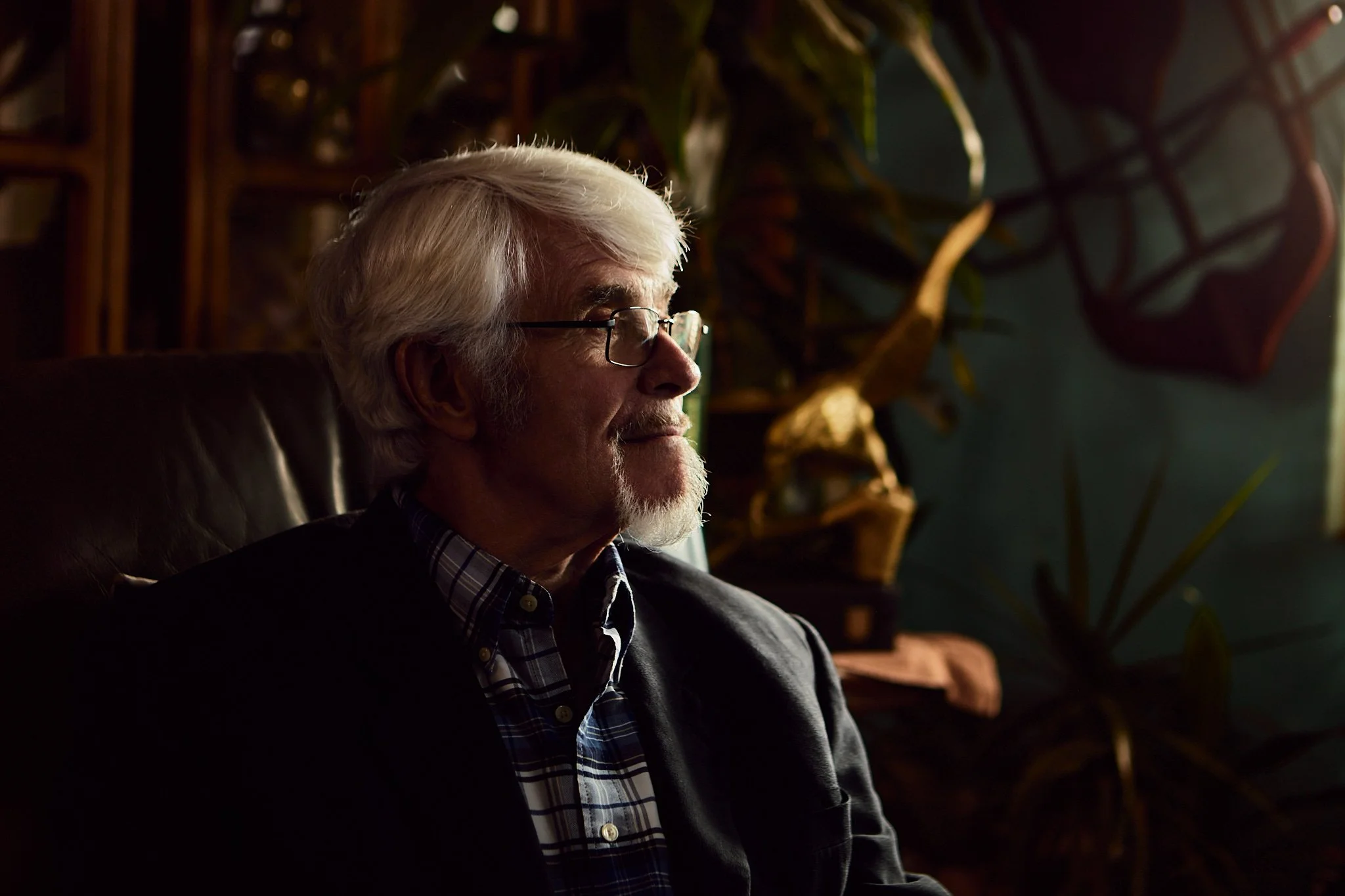
Going in for a tighter frame.
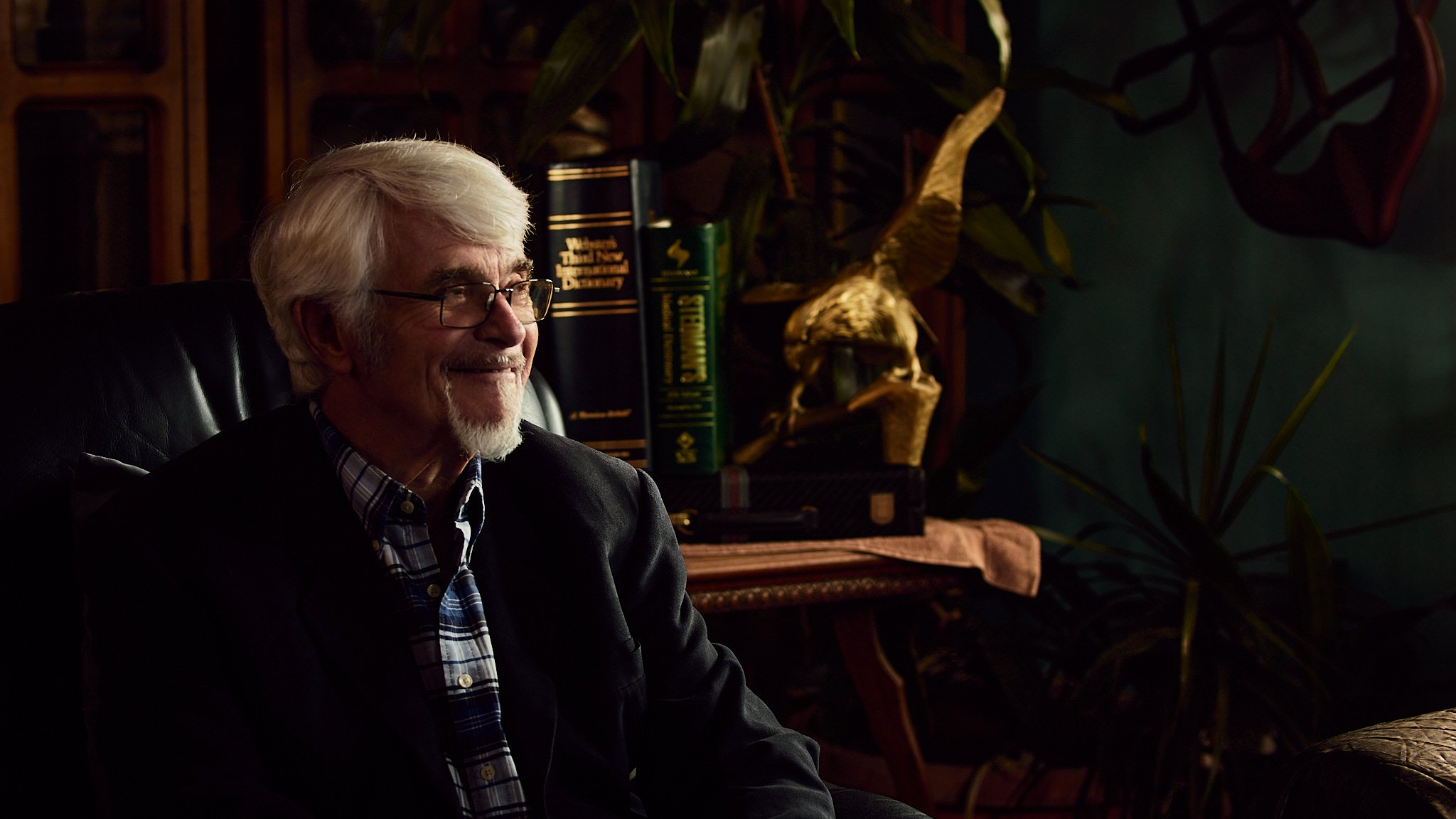
"This is for my obit photo," he says, glancing at Theo.
Upstairs in the office, the back-and-forth kept going, the way it does once somebody's forgotten to be nervous.
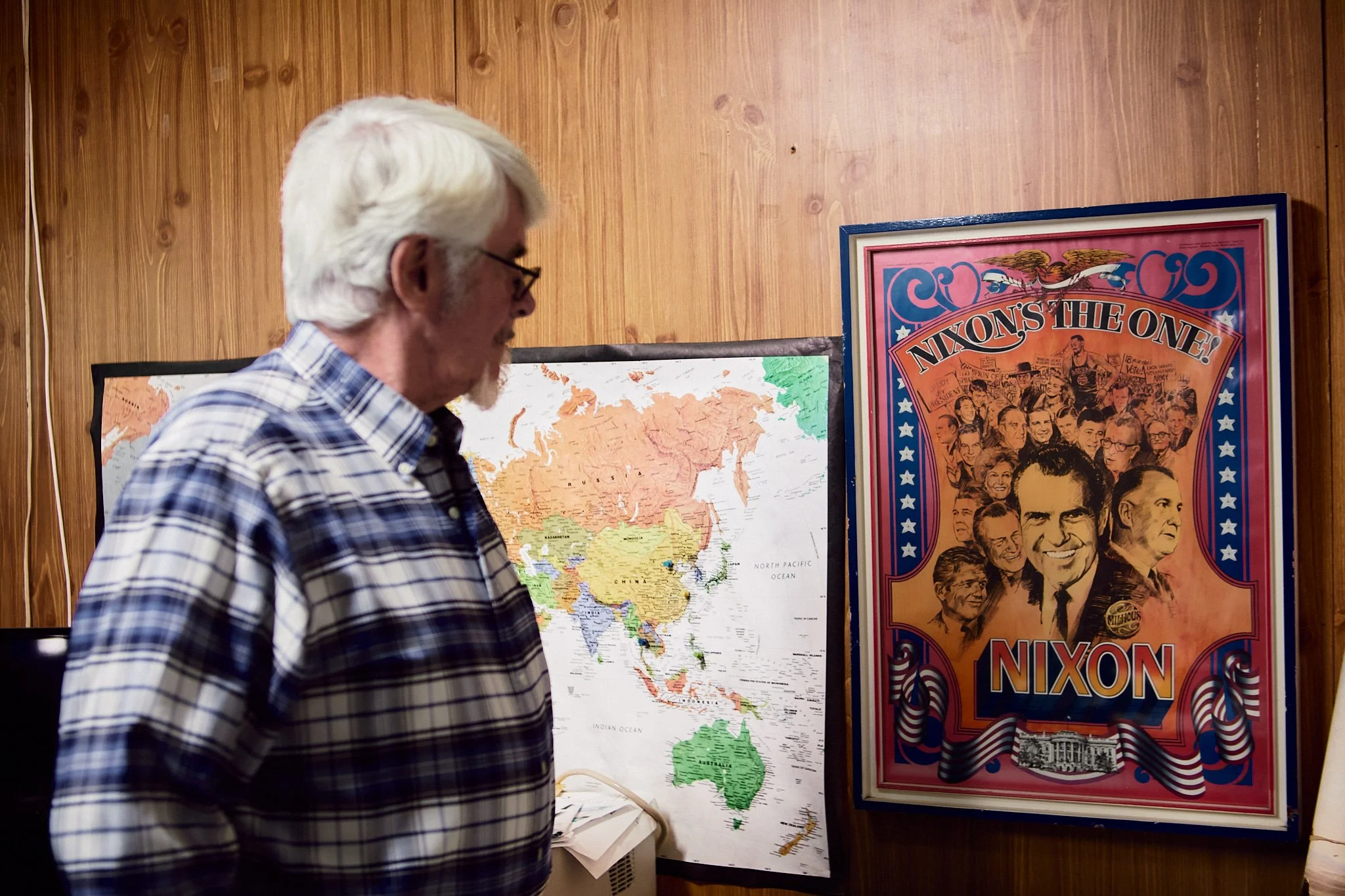
JULIAN: Here is what I want, hold it. Actually, no, I like that one, I remember you showing me that one. For the first shot, a little closer to the desk, hands in the pockets, looking at the poster, Don? Perfect. Do you have that picture of you at the inauguration?
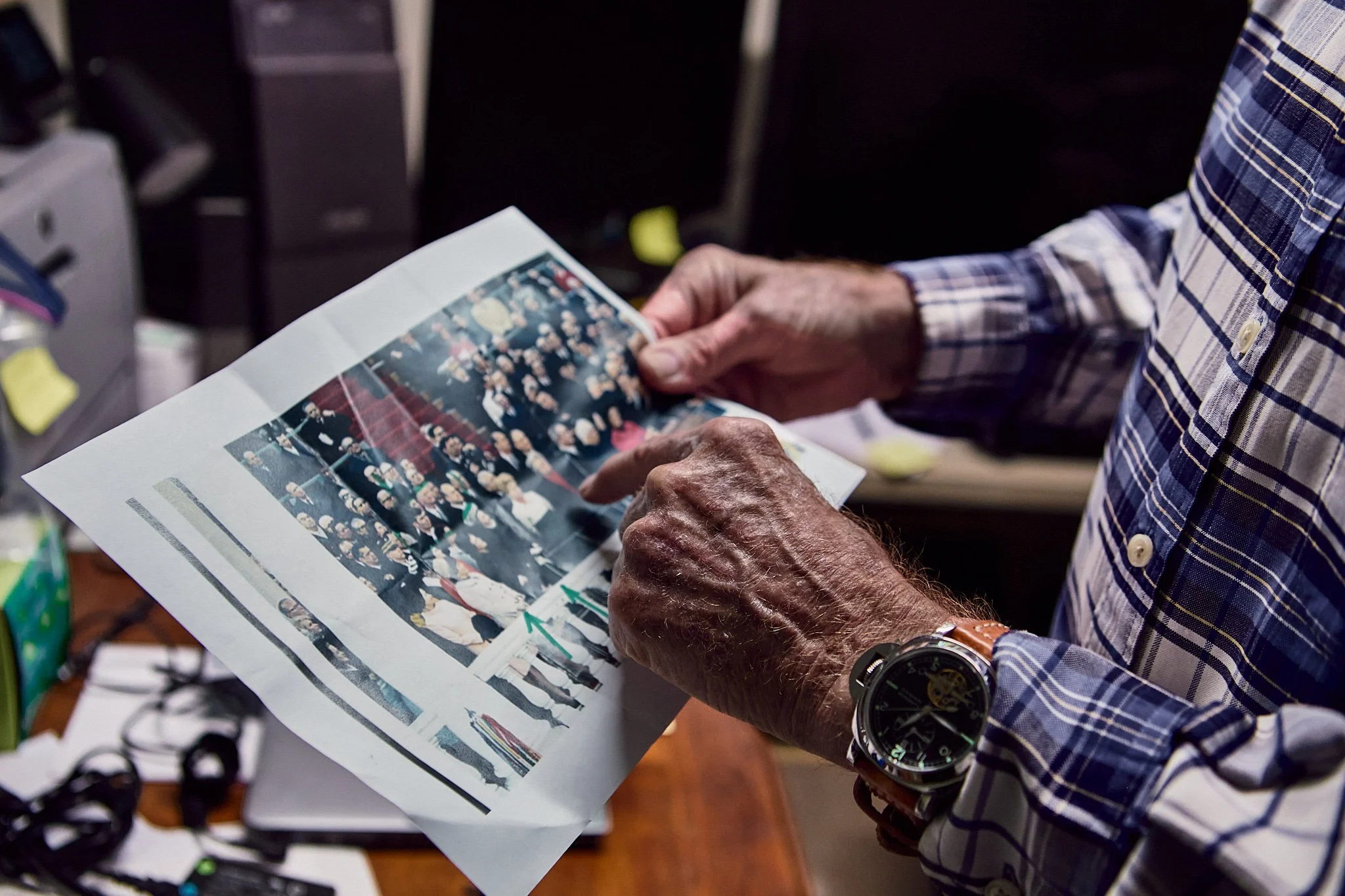
DONALD:[naming the people in the photo] Secretary of defense. The attorney general. You can see where we were. And my mom.
JULIAN: Very nice. One more, a little higher up, for the perspective. 3..2..1…
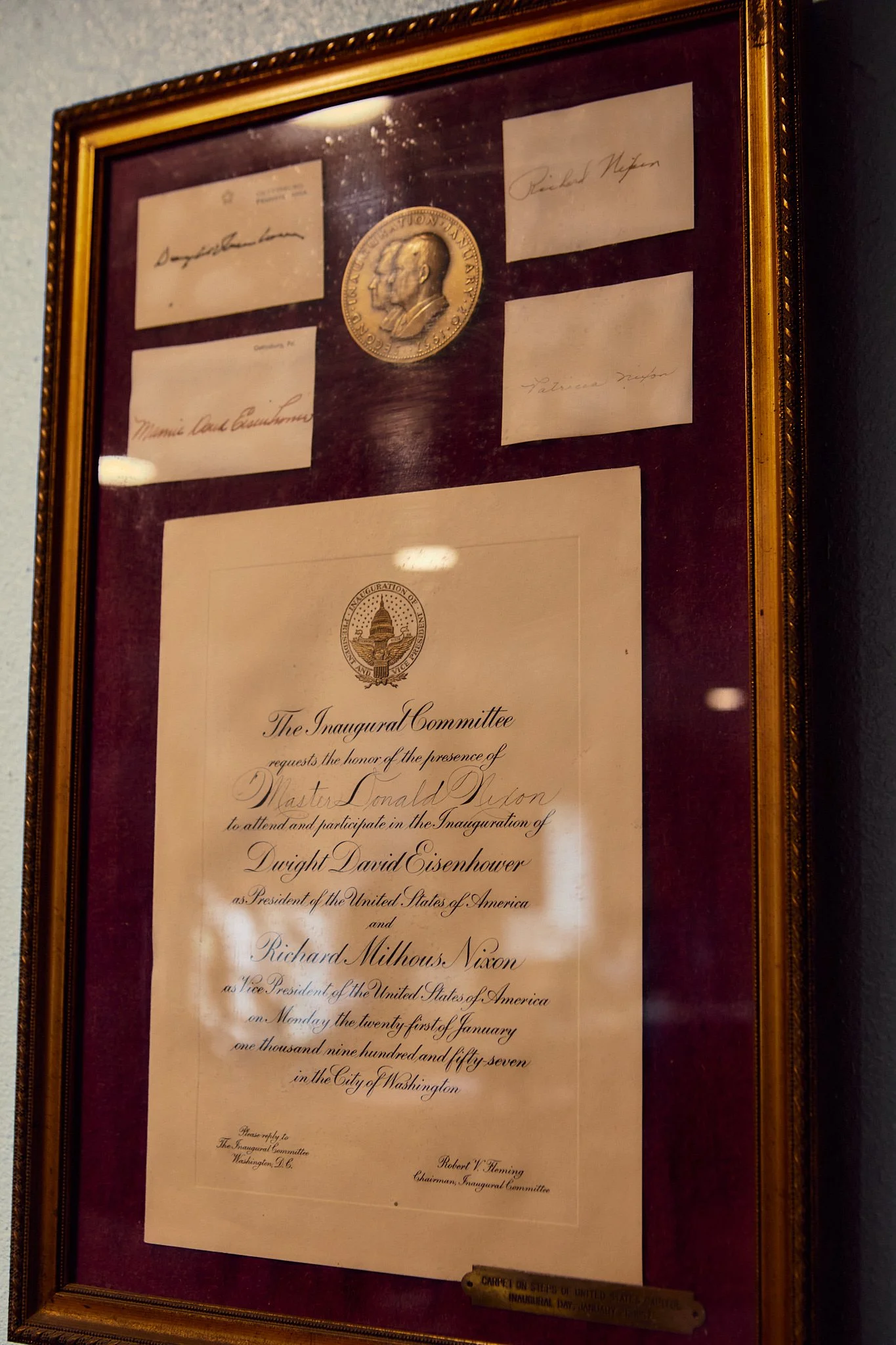
DONALD: This is just the VP stuff. My family, the cousins. 1957.
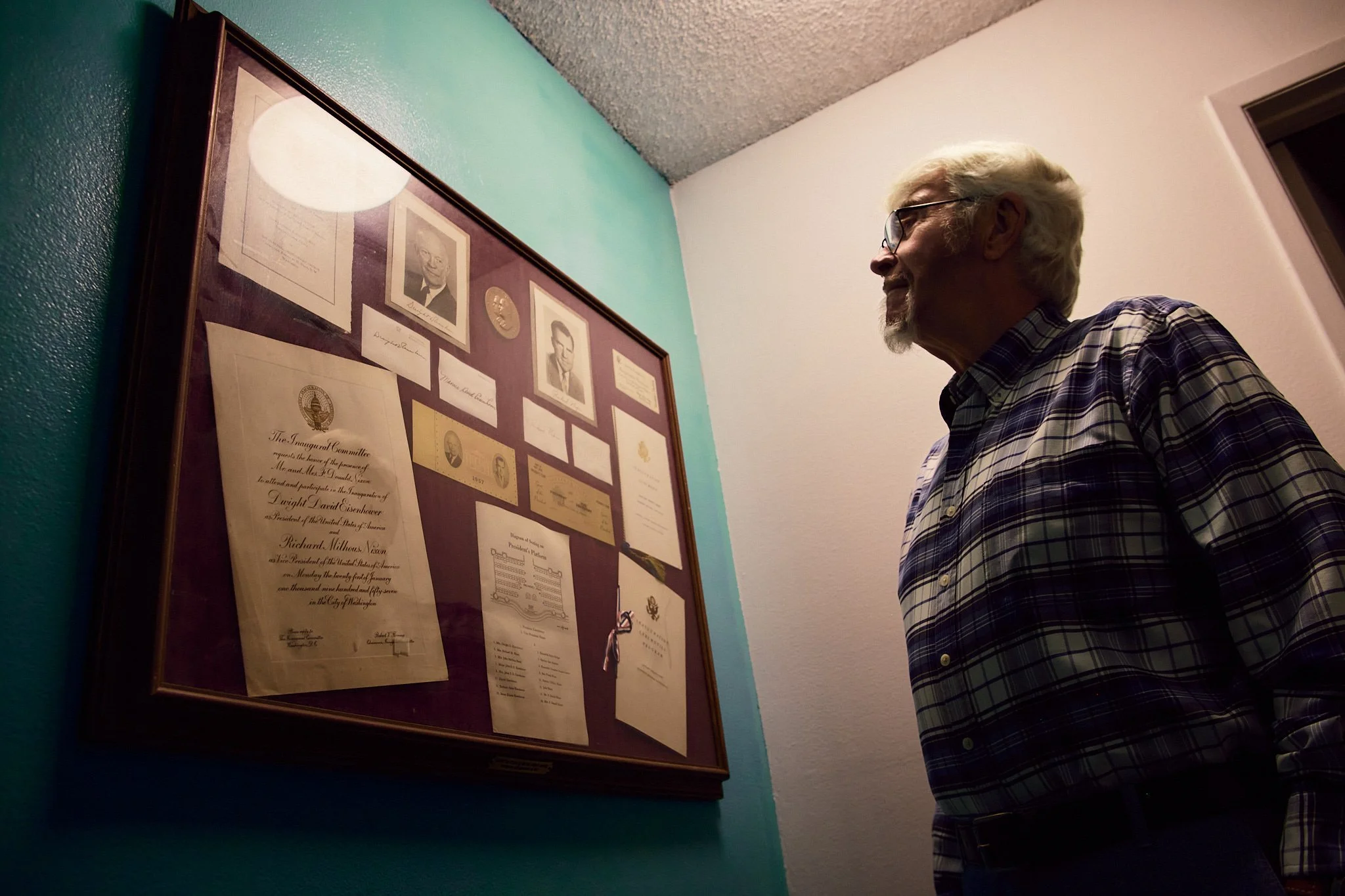
JULIAN: Stay right there, I’m going down the stairs to get a better angle. Lift your head so the light strikes your face.
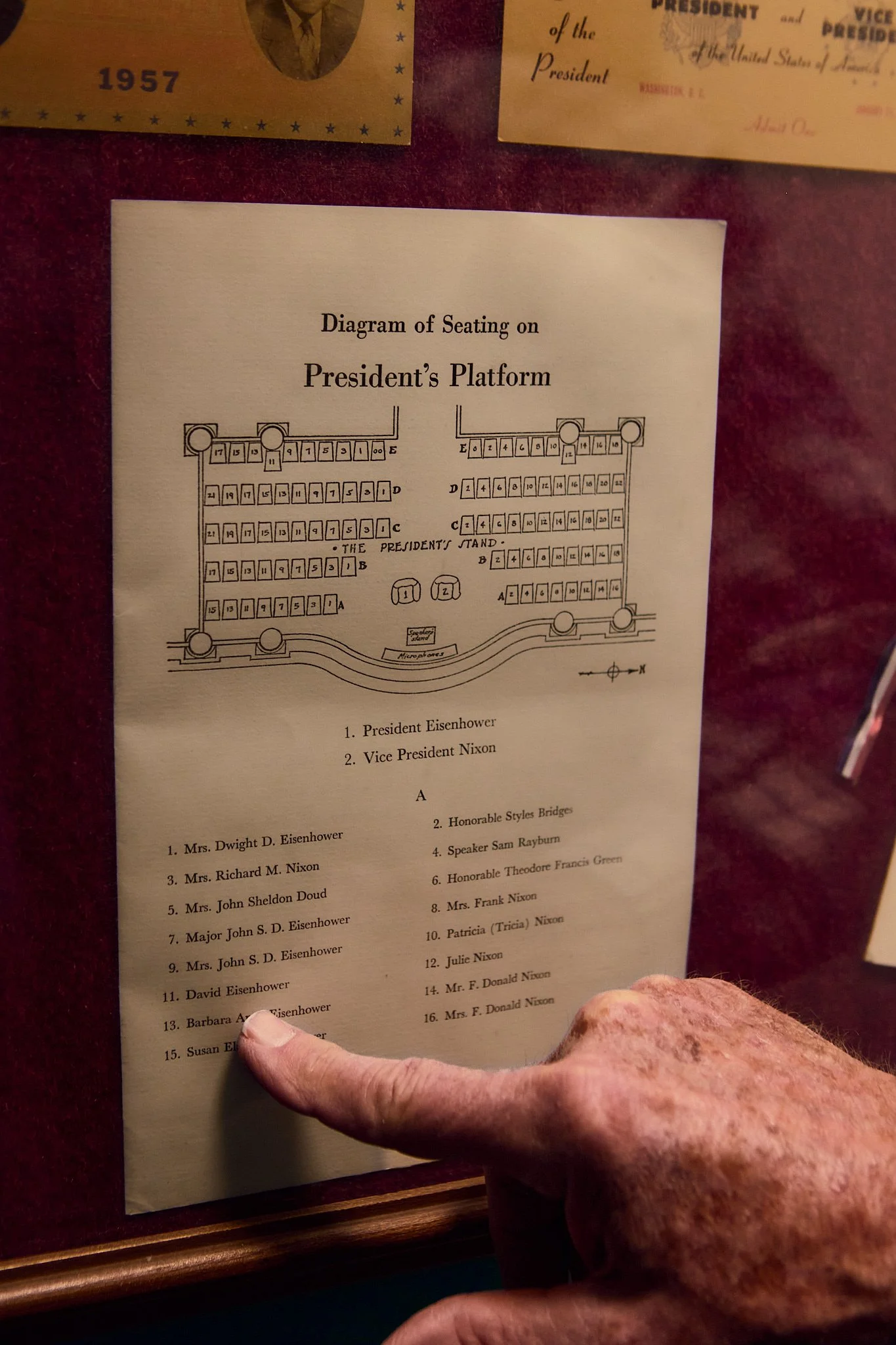
DONALD: And This is David Eisenhower, Dwight’s son, who married Julie Nixon, Dick’s daughter. She is still alive and on the board of the Richard Nixon Foundation.
That photograph he kept calling "just the VP stuff" turned out to be backed up, when I looked closely at the shelves, by the printed seating diagram for the President's Platform, January 1957. Read down the list of who sat where, the Eisenhowers, the grandchildren, the Nixon girls, and there in plain type: Mr. F. Donald Nixon. Mrs. F. Donald Nixon.
Moments In-between
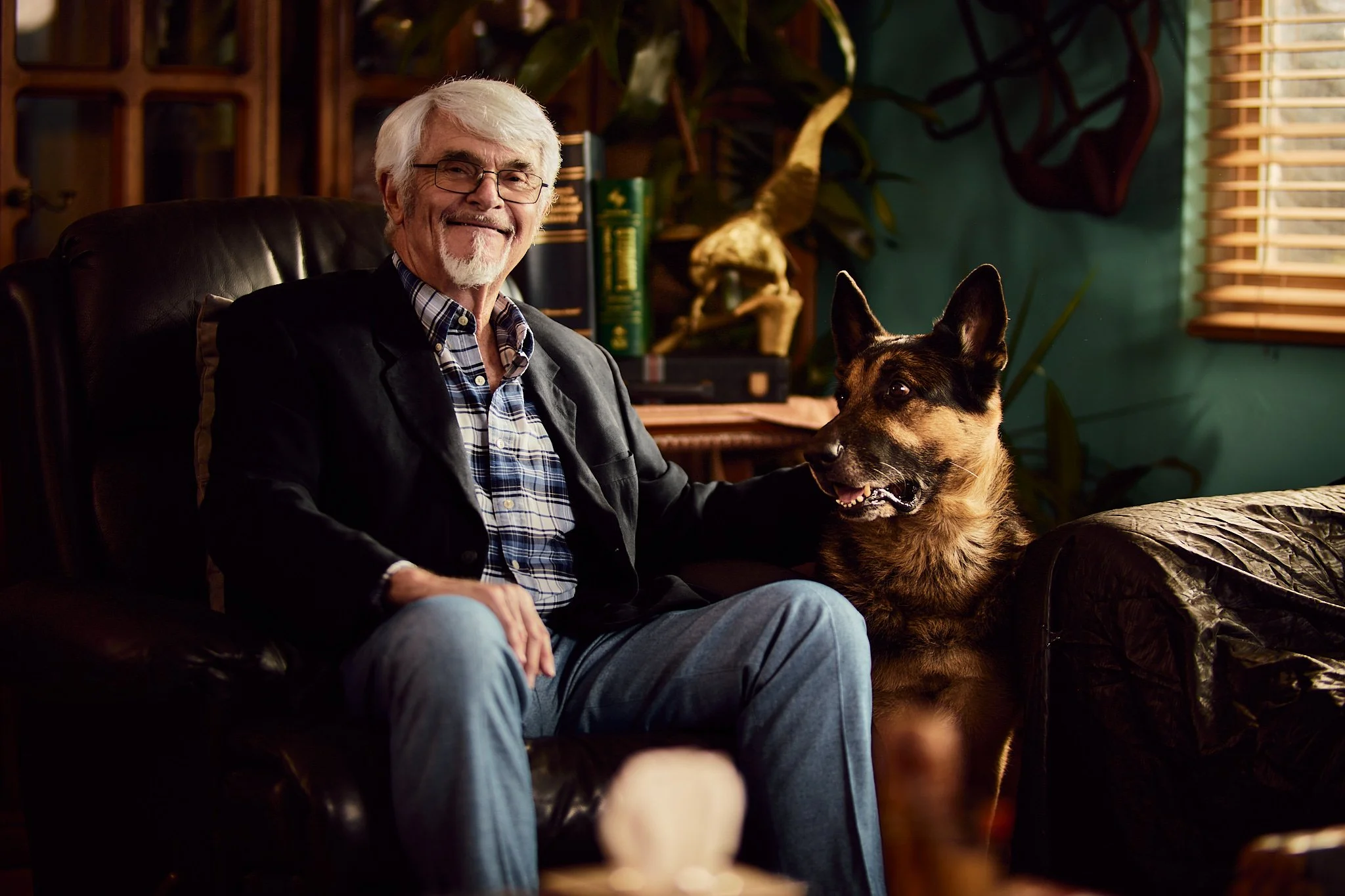
Donald and his trusted partner, Rocky.
Partway through, Rocky wandered in, and you cannot keep a dog like that out of a session he has decided to be part of, so we let him have it.
JULIAN: Rocky, sit. That hand, perfect. Almost. Rocky, up. Stay. Three, two, one. Got him. Excellent.
Rocky is a German Shepherd, and Donald's whole face changes around him. That's his boy, and he means it the way a man means it about someone who saved him as much as he saved them. Rocky came out of Kyiv, struck by an artillery shell in the first days of the war, carried halfway around the world to this sunny room. I do not think it is an accident that the two of them found each other. A man who came home from a war nobody thanked him for, and a dog who came home from one too. They have the same quiet in them. They sat together like they both already knew that. Some of my favorite frames of the whole day are the two of them, his hand on the dog's back, both of them looking like they own the place. They do..
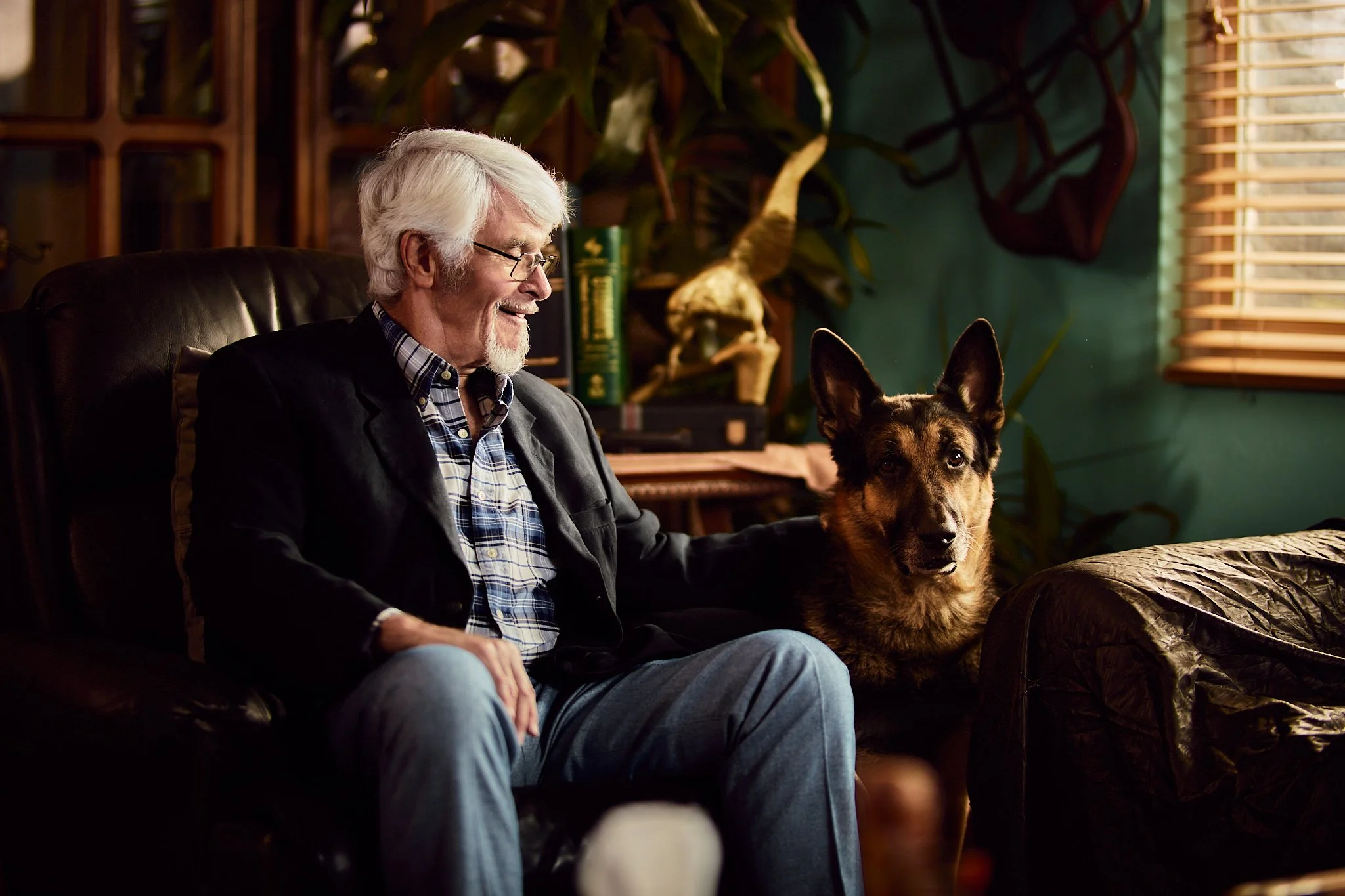
Memorabilia and More
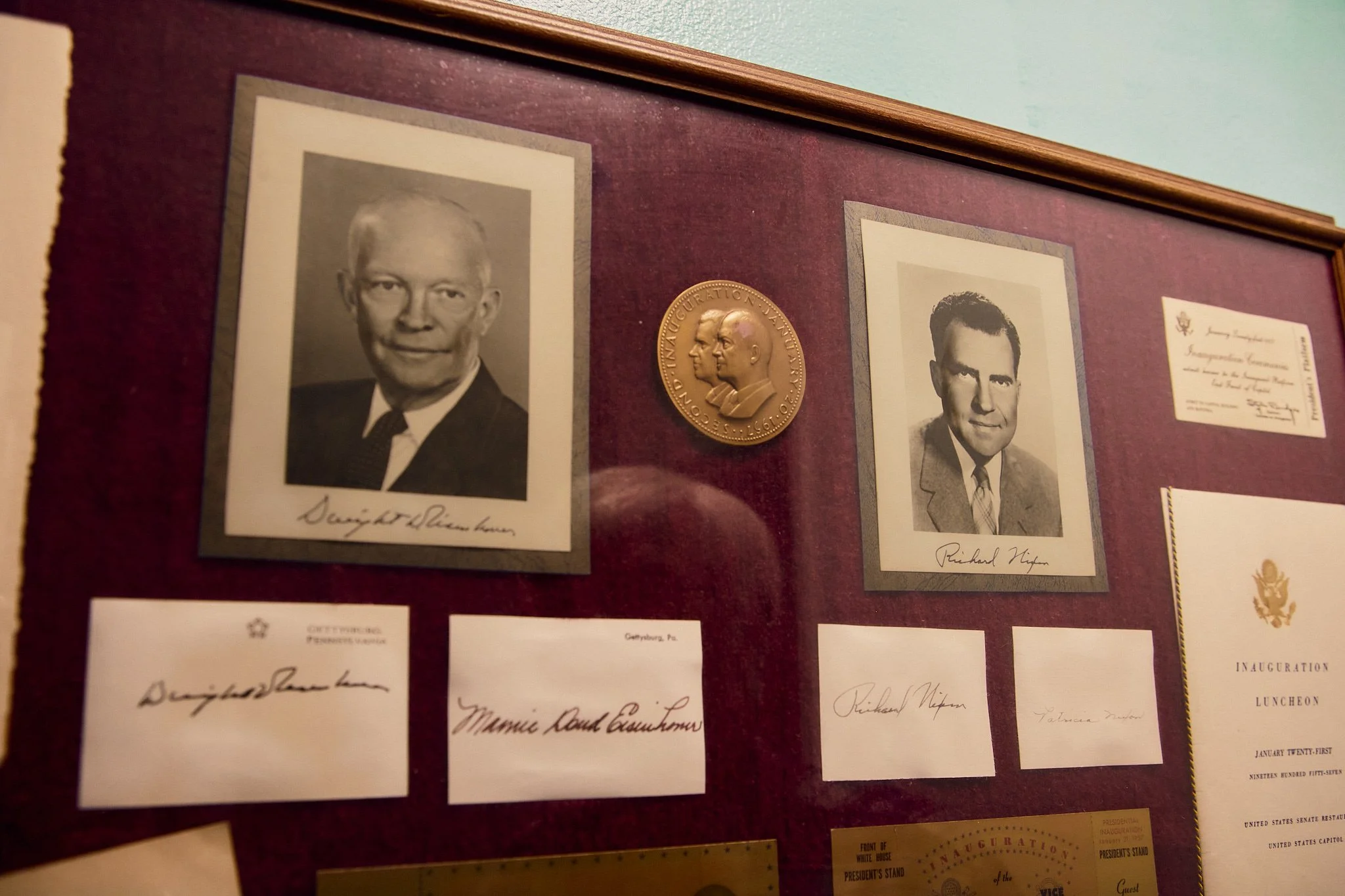
1957 Inauguration memorabilia, continued.
JULIAN: Is there anything you want to show off in particular?
DONALD: I knew that was coming. So many things. So so many things. I have something upstairs I want to show you.
There is a framed shadowbox on deep burgundy velvet, signed portraits of Eisenhower and Nixon, the bronze 1957 inauguration medal between them, signature cards from both couples, the luncheon program from the United States Senate Restaurant, and the admission card to the President's Platform.
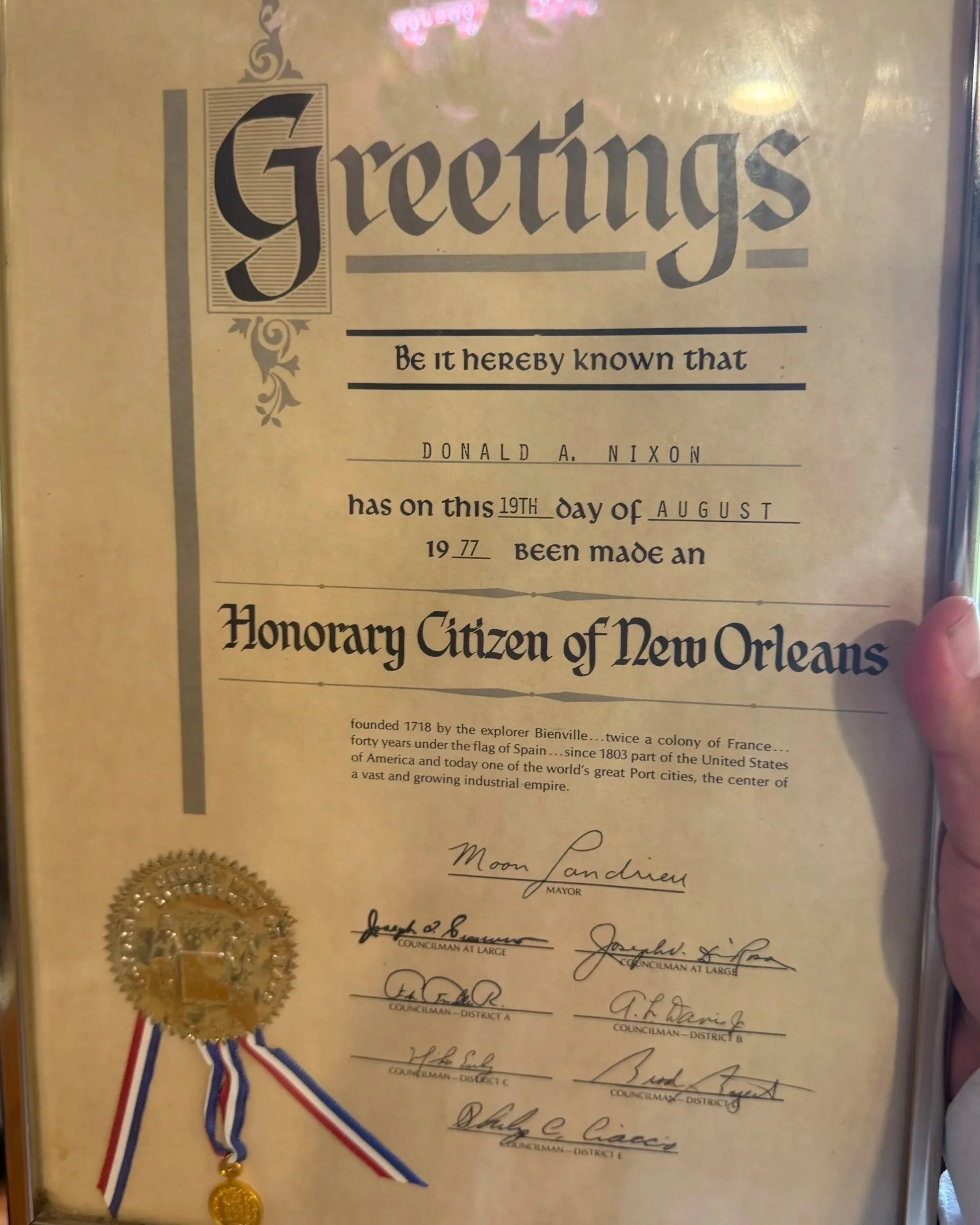
New Orleans honors from 1977, an Honorary Citizen certificate signed by the mayor.
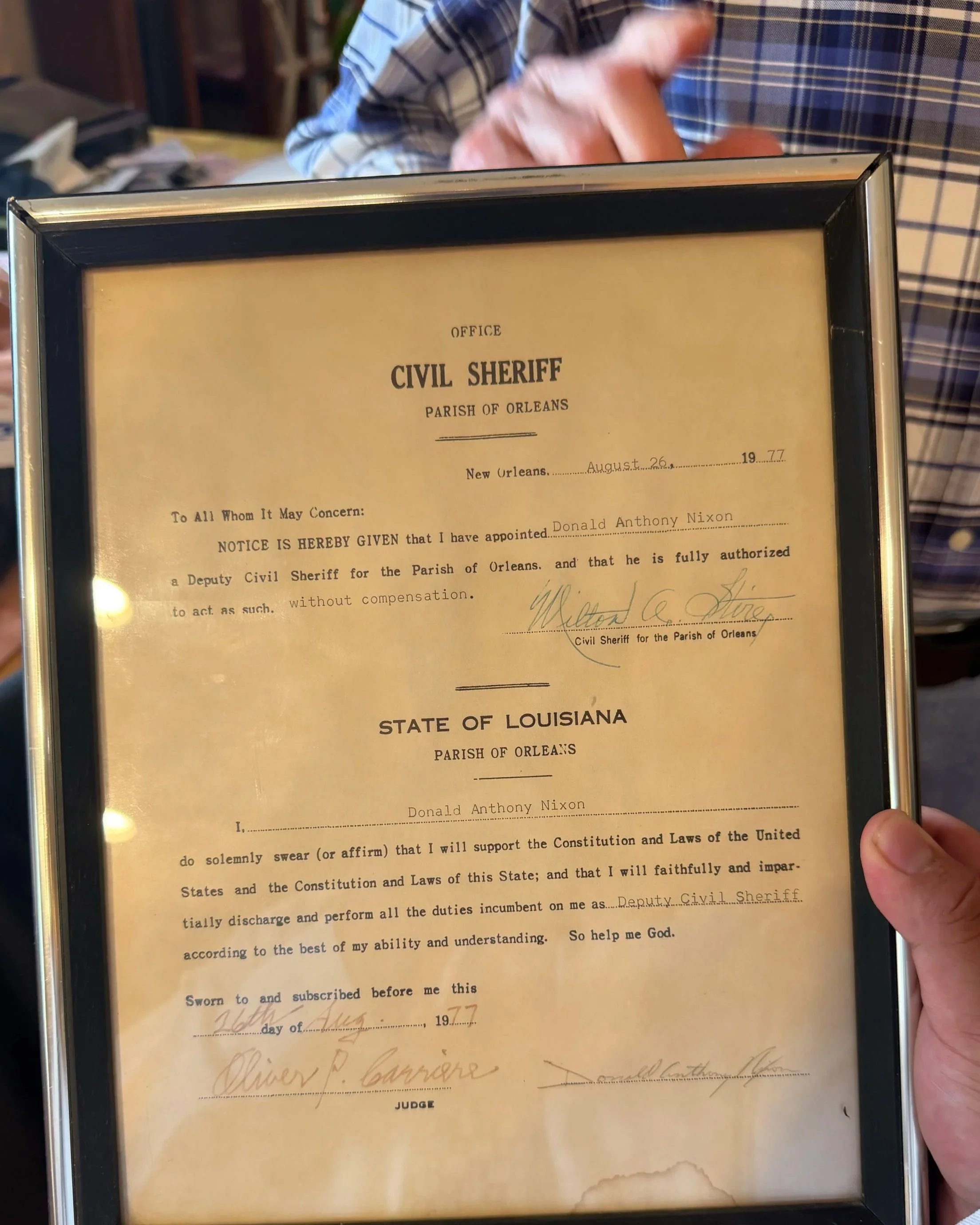
An appointment as a Deputy Civil Sheriff of the Parish of Orleans, sworn before a judge.
Golf Goodies
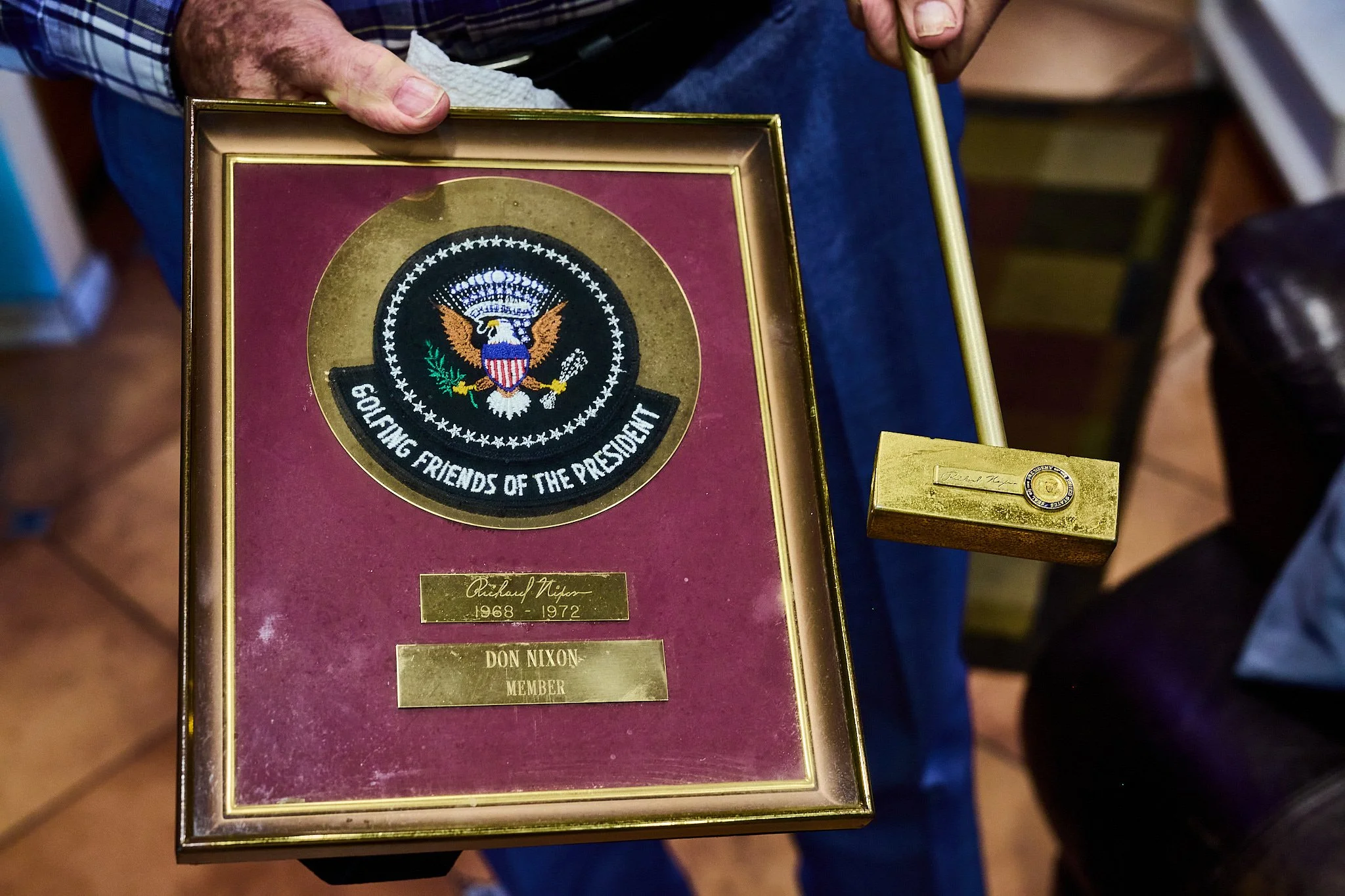
Golfing Friends of the President seal and Golden Presidential Putter.
And my favorite, given how hard he insisted he is not a golfer, a framed patch with the presidential seal ringed in stars, the banner reading GOLFING FRIENDS OF THE PRESIDENT, and a little brass plate underneath it. DON NIXON, MEMBER.
JULIAN: So you did golf with him.
DONALD: Very rarely. I am not a golfer. Not even a little. But they made me a member anyway.
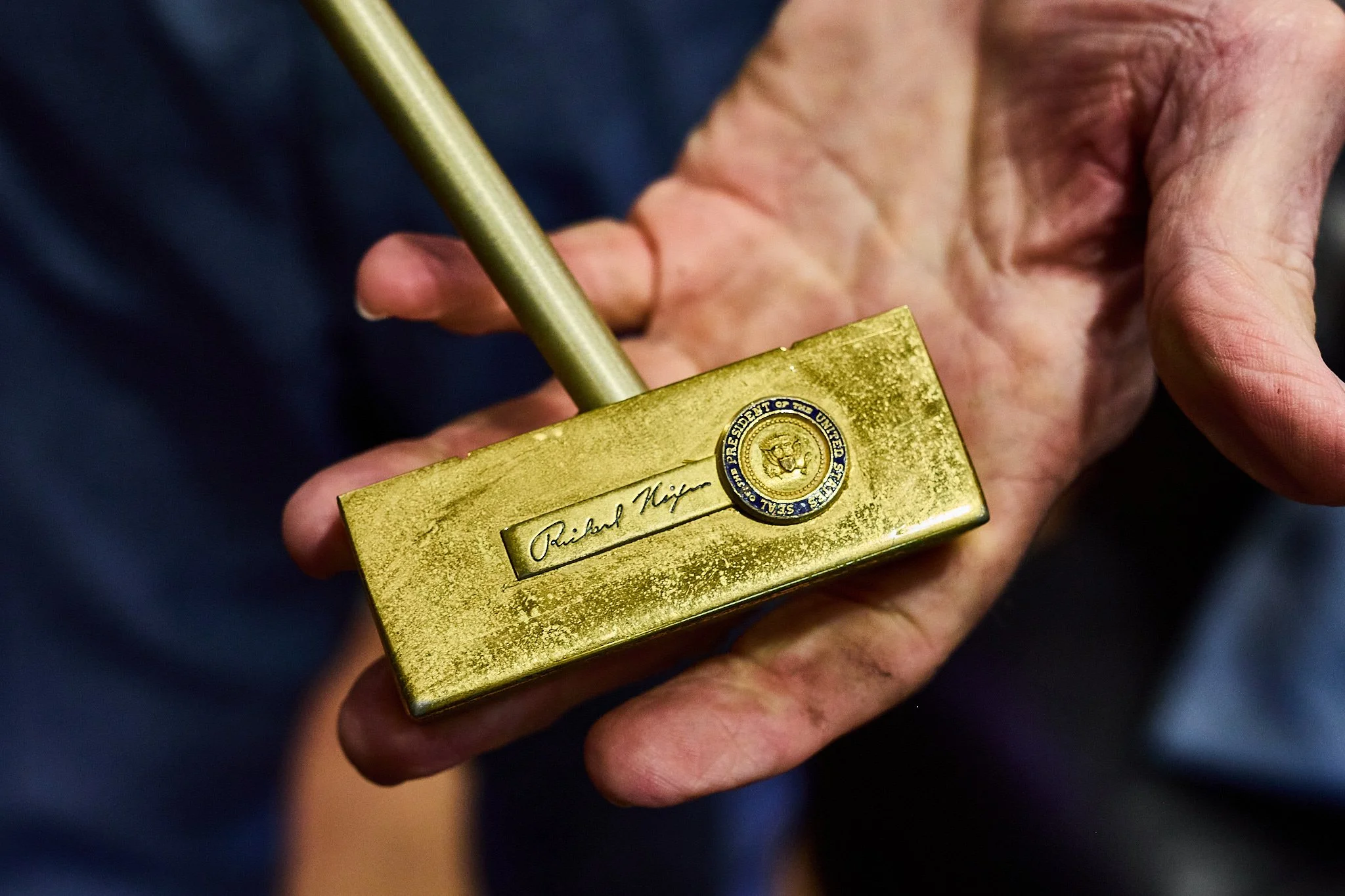
He has the putter to go with it, too, a gold presidential putter that looks like it has never missed, and when I asked him about it he just turned it over in his hands like it was the most natural object in the world to own. The skis mounted over his window are from the Mineral King days, and around them sit the brass eagle, the books, the green walls, and the dog asleep somewhere nearby, a whole life arranged on shelves by a man who pretends not to care that you are looking at it.
Dinner
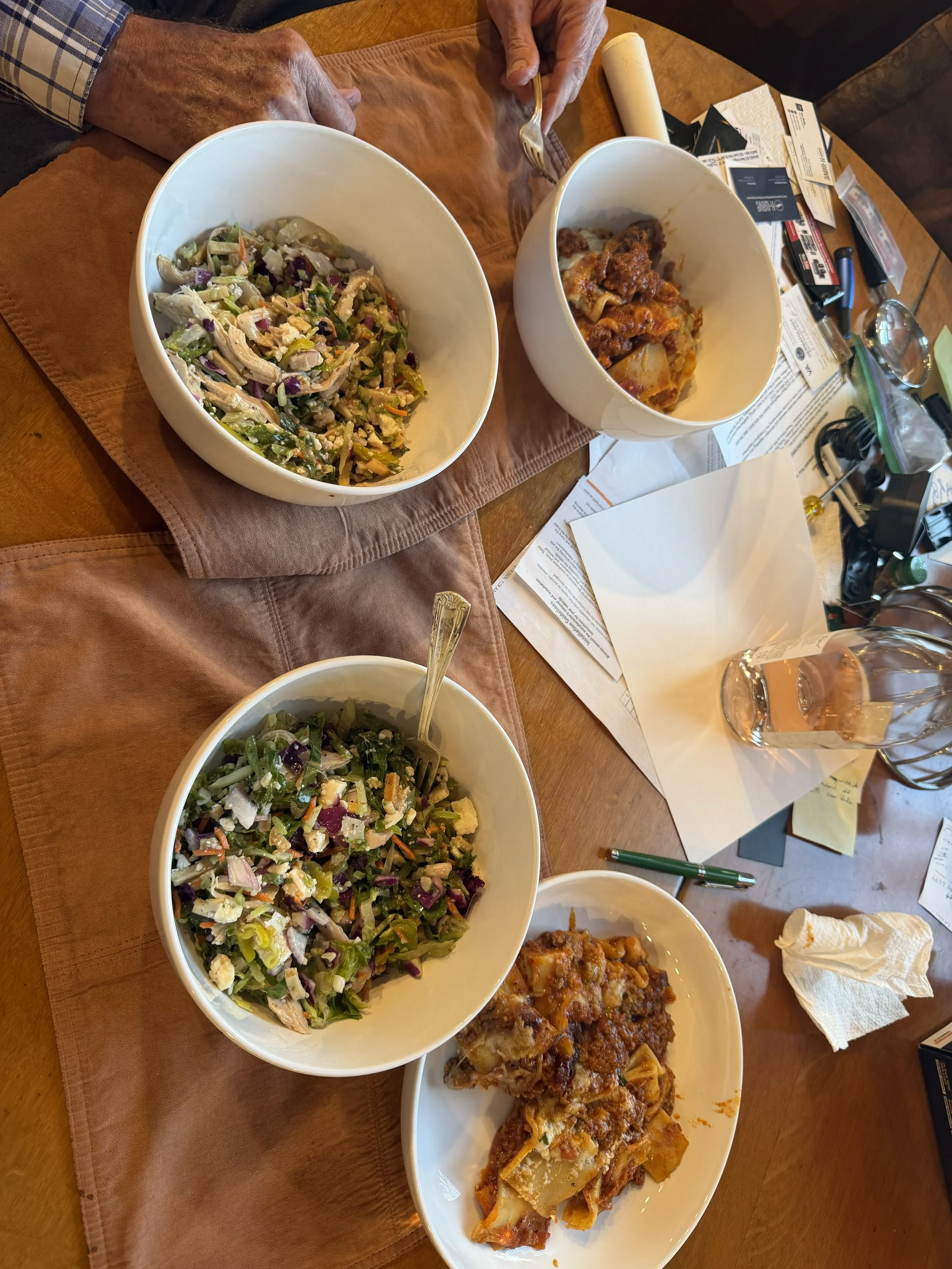
Lasagna & Mediterranean Chicken Salad.
He cooked again that evening, lasagna and a chopped Mediterranean chicken salad, and we sat back down at the same table where the day had started, a timer ticking somewhere on the counter and the oven still throwing heat into the room. Anticipating the food, we began trading our notes of favorite meals.
JULIAN: Most of my favorites come out of the Park Club in Costa Mesa. Chef Daniel Hohng is a genius. There's a lobster and avocado croissant roll there that's incredible. Snow crab leg with squid ink pasta, Australian Wagyu. It's magic.
DONALD: On the 707 we had our own chef. Made some really good stuff. Filet mignon, lobster, you name it. The crew couldn't get enough.
JULIAN: I can’t compete with a private jet, Don.
DONALD: Nobody can. That's the point.
He wanted to open a bottle of wine but could not find the corkscrew, so we spent a good few minutes hunting through drawers for it. The best parts of our transcripts were usually the small fumbling interactions nobody plans.
DONALD: Well, do you want some wine? I'll pop some open for you.
JULIAN: I think so.
DONALD: Whispering Angel. Some rosé.
JULIAN: Nice. What's the best wine you've ever had?
DONALD: Château Lafite Rothschild. And Château Latour.
JULIAN: Oh, Fancy!
DONALD: Oh, yeah. Those are real wines. 47, 48, 49. All great years, not much of a difference between them.
JULIAN: Of course.
[The hunt for the corkscrew continues. We get sidetracked.]
DONALD: Maybe we got rid of it with everything else. No, this is where I keep it. It's fine. I'll find it. Where the heck is it.
JULIAN: Wait, is that a Nixon Burger sign?
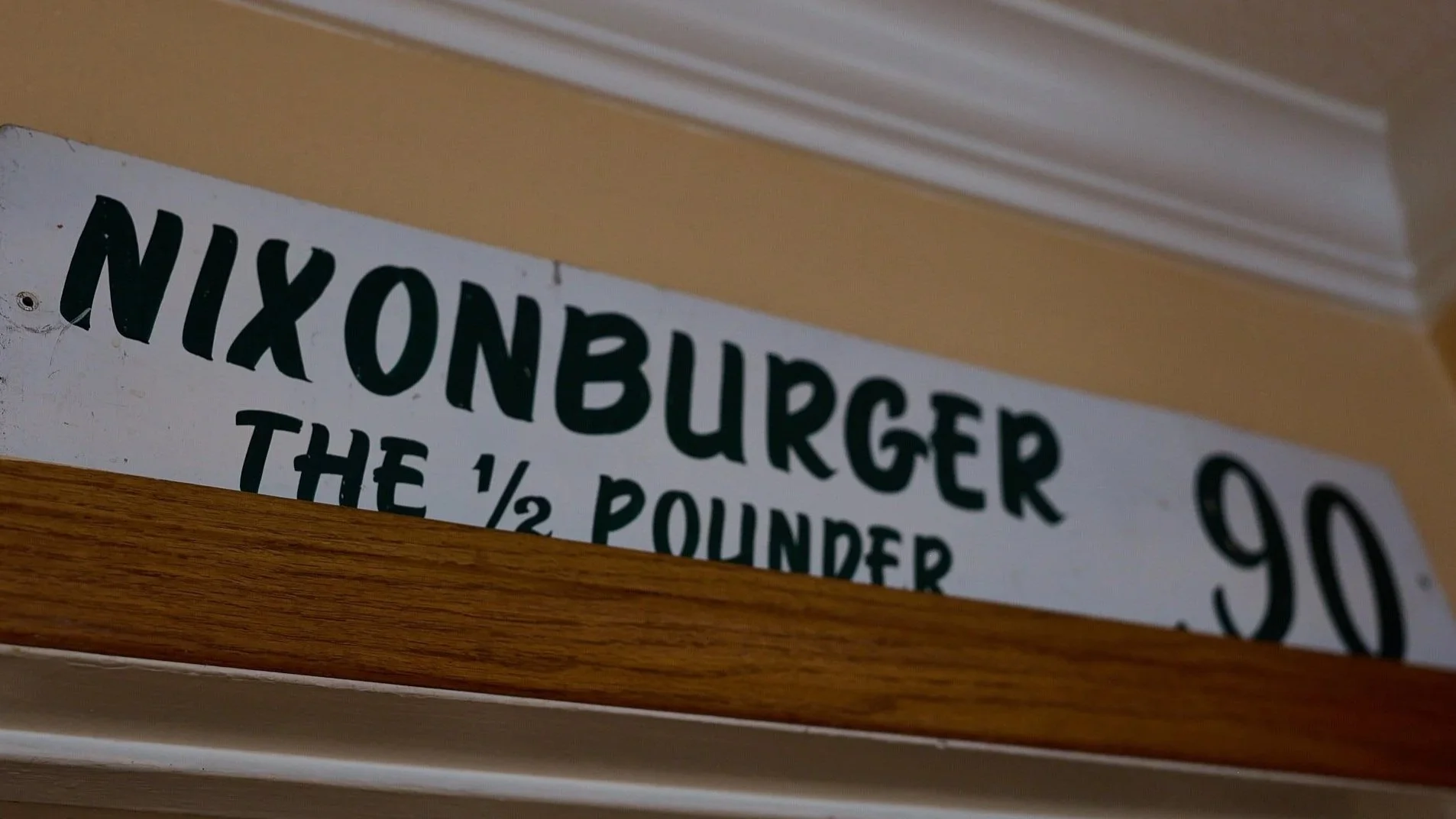
DONALD: Oh, they were famous, man. We built a whole bunch of new restaurants and sold them to Bob's Big Boy.
JULIAN: So they bought the Nixon Burger? Was that up here in Yorba Linda?
DONALD: No, no, Whittier. Whittier and Disneyland, and a bunch of them all over the place.
We found the corkscrew. I asked him to go deeper on the French wines, and he gave me a story instead.
DONALD: Well, here's a good story. I was driving from Geneva down to Monaco, for the race, and there's a fog that comes in, thick, you can barely see the road on the mountain, which drops off a cliff by the way. and there's this old man on the side of the road, a bag over his shoulder, struggling along. Real old. So I stop, back up. I said, that man needs help.
JULIAN: So you picked him up.
DONALD: Put his bag in, started driving. He says, up the hill a little bit. And there's this rock wall, built by hand, goes on and on for a couple of miles all the way to the entrance. So I pull in, and it just goes up and up, all vineyard. And all of a sudden the whole family comes pouring out. Grandpa's car had quit on him. He's the owner of the whole thing. Château Neuf du Pape.
JULIAN: You gave a ride to a stranger and he turned out to own one of the famous vineyards in France.
DONALD: The real stuff. The bottles with the two crosses on them. I'll tell you. He was so happy.
That's the thing I want you to take from all of it. It was never a man getting his portrait done. It was a few people eating and talking about wine and travel and family for the better part of a day, and the photographs are just what was left over from a good conversation. That's the only way I know how to do this work.
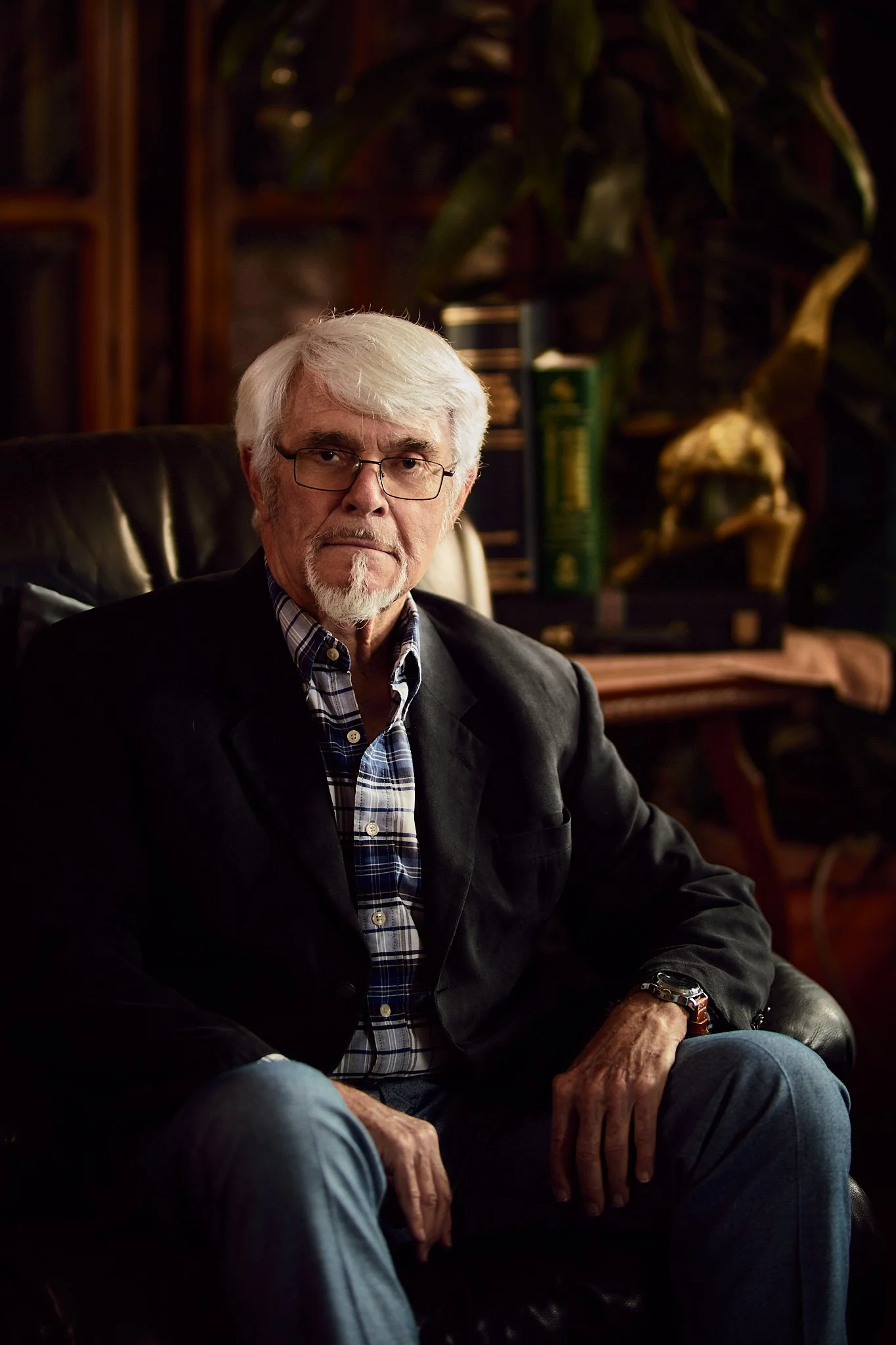
We finished in his car, a Cadillac his son had been bringing back to life, and we took it out with the recorder running and the afternoon turning gold. It happened to be Memorial Day, which felt about right, because before Donald was the patriarch of this family, before the jets and the vineyards, he was a young man sent to a war, who served, and came home to a country that looked away. So I asked him the only question that mattered.
JULIAN: One more question, Uno más.
DONALD: [grumbling, good-natured] I thought you said one more an hour ago.
JULIAN: What is your message to people?
He didn't answer right away. The pause stretched long enough that I thought maybe he hadn't heard me. He kept his eyes straight ahead, out the windshield, down the road, and something moved across his face, the way they say your whole life passes in front of you. The whole eighty years of it seemed to go by in that silence. And then he said it, slowly, leaning on every single word, like he needed me to feel the weight of each one.
DONALD: Be kind to others. Help others when you can.
He believed it with his soul. You could hear it. From most men that's a greeting card. From a man who has seen what he has seen, who could have led with any of it and chose that instead, it is closer to a confession of what actually mattered.
And I will be honest with you, because he was honest with me. That is the exact thing my own mother taught me, growing up. Be kind. Help when you can. Do things for the people. I think that is why the two of us fell into step so easily across that long day, a photographer and a Nixon. Underneath the suit and the stories and the famous name, we believed the same handful of things. When you have already been pulled out of your own life once, and lived to come home, the night your uncle wins the presidency really is just another Tuesday. And the only thing left worth saying, at the end of all of it, is be kind.
That was the man I came to photograph. Not the name. Not the stories. The one who answers his own door, cooks you dinner, tears up at his own father's memory, and means every word of that small, good advice. I made his portrait so that long after the stories blur, the family will still have the face that said it.
Put that on a wall. It will outlast every one of us.
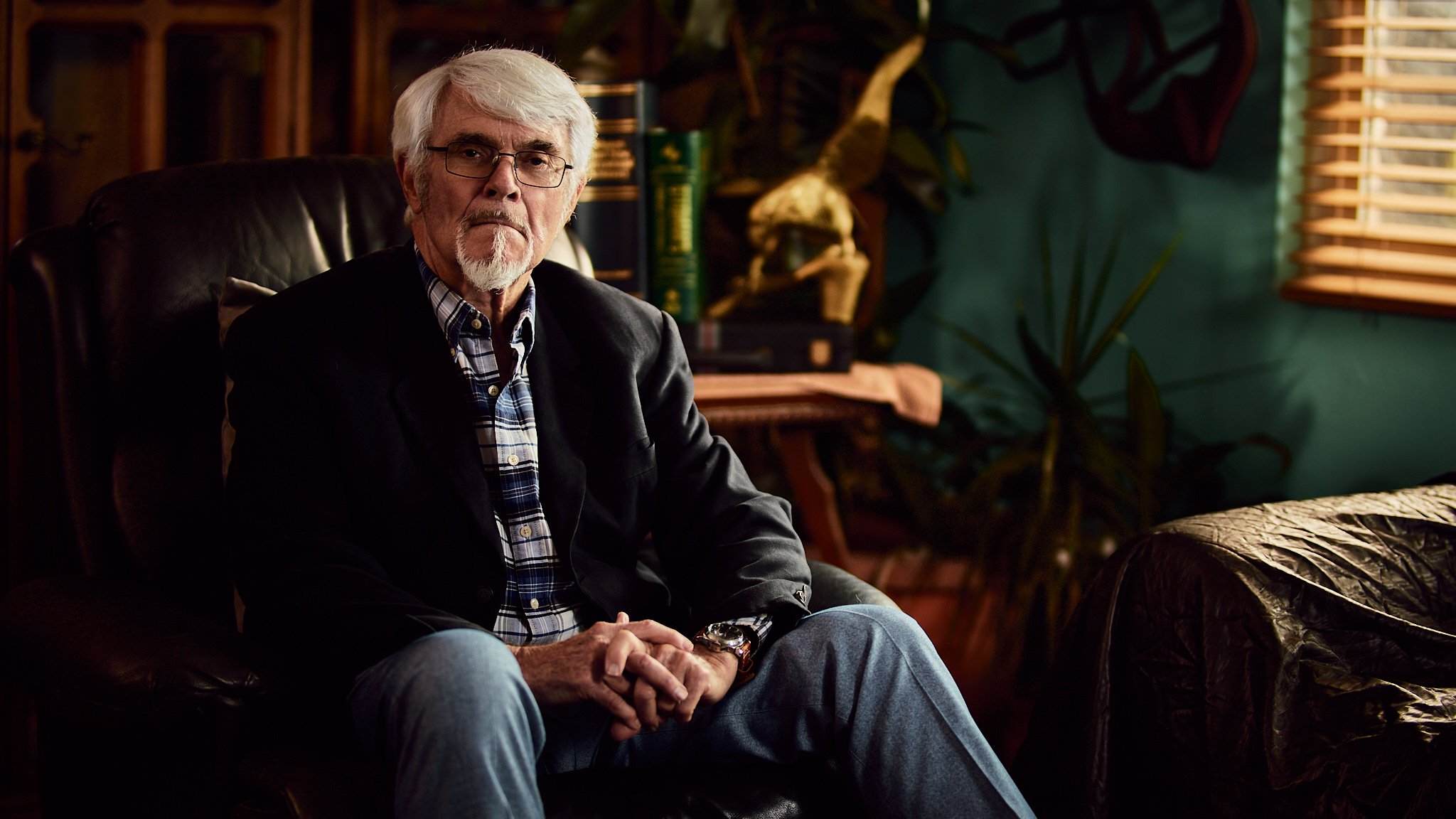
Donald Nixon Jr., Circa May 2026.